Dishwashers
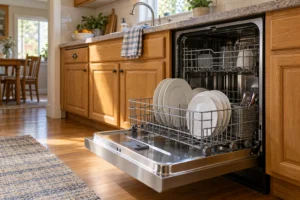
Kenmore dishwashers we repair in San Francisco: lineup, label location, leaks, drain and start problems, error codes and safe checks before you…

Specialized Kenmore Appliance Repair in San Francisco
Mon–Sat: 8:00 AM – 7:00 PM
Gray water in the tub, a leak at the door or a dead panel: we trace the cause, give a written estimate and wait for your approval.
Kenmore repair checklist · San Francisco Bay Area
When a Kenmore dishwasher quits, the symptoms are rarely subtle: a load that comes out gritty, a tub with a standing pool of gray water, a door that drips onto the cabinet floor, or a panel that does nothing when you press Start. Each of those leads to a different part of the machine. In San Francisco kitchens, where the dishwasher usually sits in a tight run of cabinets next to a disposer and a small sink, the cause is often just as likely to be the plumbing around the dishwasher as the dishwasher itself.
Standing water points to the drain path: a clogged filter or screen at the bottom of the tub, a pump that is jammed by glass or a fruit pit, a kinked drain hose, a disposer knockout plug that was never removed, or a check valve that is stuck. A drain pump that hums but does not move water is a different job from one that is silent. Our dishwasher not draining article works through the likely order.
Cloudy glasses, food left on plates and detergent stuck in the cup can come from low water, a blocked spray arm, a clogged filter, a dispenser door that does not open, or a wash pump that is weak. The cause is sometimes plain: an overloaded rack or a hot water tap that never warmed up. See why a Kenmore dishwasher is not cleaning.
Water at the front corners suggests a door gasket or latch issue. Water that appears under the dishwasher from the middle or back can come from the inlet valve, a supply fitting, the pump housing or a hose clamp. A leak sensor in the base may stop the cycle and sound an alert, which protects the floor. More detail is in Kenmore dishwasher leaking.
A dishwasher that will not start can have a door latch or switch problem, a control board fault or a thermal fuse. One that starts but does not fill points to the supply valve or inlet screen. A cycle that finishes with wet, cool dishes is a heating or venting issue. Our not-starting troubleshooting article covers the basics.
Many Kenmore dishwashers flash a code with lights or a display. This site has pages such as OE for not draining, IE for not filling, FE for water overflow, HE for a heating failure, F8E1 for a slow drain and F6E2 for a water inlet valve failure. Others appear as blinking light patterns, and some models use two-digit pairs like 8-1 for the same fault as F8E1. Code pages such as E1 and F5E1 help you read what the machine is reporting. See our dishwasher error codes article and the full code pages. A code identifies a circuit or condition. It does not by itself prove that a single part has failed.
Do not remove the lower kick panel, unplug electrical connectors, or reach into the pump area. Never put a screwdriver into the drain hose or the latch.
Turn the dishwasher off at the breaker if you smell burning, see sparks or find a hot, discolored plug near the sink cabinet. If water is spreading, close the supply valve under the sink. A leaking unit above a neighbor’s ceiling is reason to book quickly.
Parts such as pumps, valves, latches and control boards differ by model, and Kenmore dishwashers span many production runs. The label is usually on the door frame or the inside edge of the tub near the top. Photograph it before the visit. Models we cover include Kenmore 22-14582 and Kenmore 587.1525, and the dishwasher lineup page lists more.
A technician starts with the drain path, the filter, the door and the supply, then moves to the pump, valve and control as needed. You receive a written estimate after the diagnosis, and nothing is repaired without your approval. We protect floors under the toe kick and put the machine back square. If you are not sure which appliance is the source of water, look at Kenmore washer repair too.
A little water in the sump can be normal. A visible pool usually means a blocked filter, a stuck drain pump, a pinched hose or a disposer plug issue.
Yes. The dishwasher drains through the disposer or the same drain line, so a blocked disposer will keep water in the tub.
Write the code down. If it returns, book a visit. A running unit with a recurring code may be warning about a sensor, heater or drain problem before it stops.
No. Water can reach the subfloor or a ceiling below. Stop the cycle, close the supply valve and call.
The model number from the door frame, the symptom, any code you saw, and whether a disposer is connected.
Kenmore dishwashers we repair in San Francisco: lineup, label location, leaks, drain and start problems, error codes and safe checks before you…
Kenmore cooktop repair in San Francisco and the Bay Area: gas burners that will not light, electric and induction elements that stay…
Kenmore dryer repair in San Francisco and the Bay Area for electric and gas units: no heat, long dry times, no tumble,…
Chest and upright Kenmore freezers that stop freezing, ice over or run nonstop, diagnosed in garages, closets and kitchens around the Bay…
Diagnosis and repair for Kenmore countertop, over-the-range and built-in microwaves across San Francisco and the Bay Area, with a written estimate first.
Share a few details and we’ll confirm an appointment. Prefer to talk? Call us and we’ll help right away.