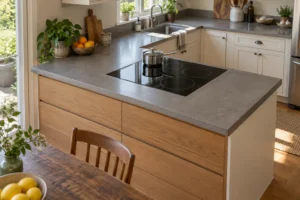
Cooktops
Gas, electric and induction Kenmore cooktops in San Francisco kitchens: what goes wrong, which codes mean what and what to try before…

Specialized Kenmore Appliance Repair in San Francisco
Mon–Sat: 8:00 AM – 7:00 PM
A built-in Kenmore cooktop sits in your countertop, so the work begins with finding what failed above and below the surface, then agreeing the repair.
Kenmore repair checklist · San Francisco Bay Area
A cooktop is installed into the counter and is not a range with the oven removed. There is no oven cavity to pull from, the controls often sit on the surface or the front of the cabinet, and the gas or electrical connection is tucked beneath the countertop. That affects how we diagnose a fault and how a repair is carried out. We service Kenmore cooktops for San Francisco and Bay Area households and landlords, and we explain what we find before a part is ordered or installed.
On a gas cooktop, trouble tends to show up at the burner. A flame may not ignite, may click again and again, may burn unevenly, or may light only on one side of the ring. The usual explanations are food or moisture in the burner ports, a cap that is not seated, a dirty or worn igniter, or a spark module that has stopped delivering a spark. A burner that lights but dies when you lower the knob is a different case from one that never sparks. Our article on Kenmore cooktop burner not working separates these, and the related guide Kenmore range burner won’t light applies to many of the same causes.
We cover a Kenmore gas cooktop, 790.3050. We make no statement about its age or availability, but if that is the number on your label, the model page is a good place to begin.
Electric radiant surfaces rely on elements, switches and sometimes a limiter beneath the glass. An element that stays cold, a zone that never reaches heat, or a cracked glass top each lead to a different decision. Induction cooktops are another matter. They heat the pan itself through a magnetic field, so they depend on the right cookware, a clean flat surface and a bank of power and control electronics underneath. When an induction zone refuses to start, the fault may be in the pan, the sensor, a control key or those boards.
If the glass is cracked or chipped, stop using the cooktop and tell us when you book, since liquid can reach the parts below.
Several Kenmore induction cooktops report faults as plain numbers with no letter in front. These numbers fall into three families. The first is key failures, where a given control is read as defective. For example, code 2 is the left front element Down key, code 24 is the Lock key, and code 25 is the main Power key. The second is sensor failures, such as code 51 for the left front temperature sensor and code 53 for the right rear one. A lone letter, H, reports an element temperature sensor problem when the element is off and cold.
The third family involves supply and communication between boards. Code 30 is an improper power supply or internal wiring failure, code 34 is a communication failure between the filter control board and the main power control board, and code 39 shows a software mismatch after a new touch control board is installed. These meanings come from the model series they apply to, so the full model number should be known before any of them is read.
A code is a starting point. A key code can come from a worn key, a spill under the glass or a loose connection, and a communication code does not tell us which of two boards has failed.
Never lift the unit, open the underside, or touch gas fittings.
If there is a smell of gas, leave the home, avoid switches and phones inside, and call the gas utility or 911 once you are outside. A burning smell, sparks, a cracked surface, or a burner that stays lit when you turn the knob off all mean the cooktop should be shut off, at the breaker or the valve, until it has been looked at.
The model number tells us the layout, the number of elements and which control family you have. It is typically printed on the underside of the cooktop or on a tag near the connection, and sometimes on the cabinet edge below. If you cannot reach it, a photo of the cooktop and any marking you can see will help us narrow it down. Read how to find your Kenmore model number for places to look.
The technician checks the supply, the surface and the controls, finds out which part has failed, and tells you plainly what the repair involves. You then receive a written estimate. Work proceeds only once you approve it, and the cooktop is tested before the visit ends.
Learn more in Kenmore cooktops. If the cooktop is part of a range, Kenmore range repair may be the better fit.
A single failing burner points to its own cap, ports, igniter or switch rather than the whole supply. A technician checks those parts in turn before deciding what to replace.
It depends on the series. Some numbers name a specific key or sensor, others point to supply or board communication. Give us the number and model label so we match it to the right table.
A cracked glass surface generally needs replacing, and the unit should not be used meanwhile. We confirm what is damaged underneath at the visit.
Yes, if you can. Removing items from the cabinet or drawer under the cooktop gives the technician room to work.
We handle both. A built-in surface is covered here, and a cooktop on a range is covered on our range service page.
Gas, electric and induction Kenmore cooktops in San Francisco kitchens: what goes wrong, which codes mean what and what to try before…
Standing water, dirty dishes, leaks and no-start problems on Kenmore dishwashers, checked from the drain path and the door latch through to…
Kenmore dryer repair in San Francisco and the Bay Area for electric and gas units: no heat, long dry times, no tumble,…
Chest and upright Kenmore freezers that stop freezing, ice over or run nonstop, diagnosed in garages, closets and kitchens around the Bay…
Diagnosis and repair for Kenmore countertop, over-the-range and built-in microwaves across San Francisco and the Bay Area, with a written estimate first.
Share a few details and we’ll confirm an appointment. Prefer to talk? Call us and we’ll help right away.