Washers
Kenmore top-load, impeller, front-load and compact washers we service in San Francisco, with model label tips, common faults and safe owner checks.

Specialized Kenmore Appliance Repair in San Francisco
Mon–Sat: 8:00 AM – 7:00 PM
Clothes soaking wet, a leak under the drum or a machine that walks across the floor. We find the cause before we repair anything.
Kenmore repair checklist · San Francisco Bay Area
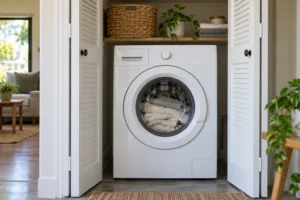
A Kenmore washer that stops mid-cycle, leaves clothes dripping, or walks across the floor during spin is a bigger household problem than it looks. In San Francisco, laundry often shares a closet, a hallway nook or a shared basement room, and many washers sit directly above living space. Below we walk through what goes wrong on top-load agitator, top-load impeller, front-load and compact Kenmore washers, and what we check first.
A washer that does nothing when you press Start may have lost power, may have a lid switch or door lock that is not engaged, or may have a fault in the control. Many front-load washers will not start until the door lock confirms it is shut, while top-loaders look for the lid switch. Our washer will not start article covers the order of checks.
A drain pump blocked by a coin, a button or a sock; a kinked or clogged drain hose; a standpipe that is clogged; or a pump that has failed. Front-loaders have a small filter behind a lower access door, which is a common place for debris. See Kenmore washer not draining.
Clothes come out soaked when the drain is slow, the lid or door switch interrupts the spin, a belt or coupling is slipping, or the motor or control is struggling. An unbalanced load can also stop a spin and trigger repeated retries. Details are in Kenmore washer not spinning.
Loud vibration comes from an uneven load, an unlevel floor, worn suspension parts, loose feet or a transit bolt left from installation. In an older flat with sloped wood floors, the cabinet may rock even when it is adjusted correctly. Our washer shaking article explains what separates a load problem from a mechanical one.
Leaks come from supply hoses, the inlet valves, the door boot on a front-loader, the tub seal, the pump and the drain hose connection. Musty smell inside a front-load washer usually points to a gasket that stays damp, soap residue or a drain issue. These are often handled by cleaning and drying habits, but a torn boot or a leaking pump must be replaced.
No fill, slow fill, or water that is never warm can trace back to the inlet screens, hot and cold hoses connected the wrong way, a water pressure issue in the building or a failed valve.
Kenmore washers may blink lights or show messages when the control sees a lid, door, drain or motor problem. Read what the display says in plain words and note anything that repeats. Write down the exact message or the pattern of lights, along with the cycle you were running. That record helps a technician more than a reset does.
Do not open the cabinet, reach into the drum during motion, or override the lid or door lock.
Switch off at the breaker and close both water valves if there is a burning smell, a loud grinding or banging that gets worse, smoke, or water running outside the machine. Do not run a washer that leaks above a lower unit or into a wall.
Lid switches, door locks, pumps, belts, bearings and control boards differ between top-load agitator, impeller and front-load designs. The label is usually inside the washer lid, along the rim of the door opening, or on the back panel. Photograph it before we arrive. Models we cover include the Kenmore 26-29162, Kenmore 26-42272 and Kenmore 110.31632610. See the Kenmore washer guide for the full lineup.
We ask about the symptom, cycle and installation, then examine the supply, drain, door or lid, and the drive and control. A written estimate follows the diagnosis, and nothing is repaired without your approval. Dryers often share the same space and power, so if both act up at once, look at Kenmore dryer repair as well.
Usually an unbalanced load, unlevel feet or worn suspension. Level the feet and rebalance the load, and book a visit if it continues.
One controlled power reset is fine: switch off, wait briefly, switch on. Do not repeat it over and over, because a recurring fault needs a diagnosis.
Often it is moisture, residue or a clogged filter. Leave the door ajar between loads and clean the gasket. A torn gasket or leaking pump needs a technician.
The washer may not be draining or spinning. Check the drain hose and the filter if you can reach it, and book a visit if water remains.
The model number from the label, the symptom, the cycle in use, and whether the washer is stacked or in a closet.
Kenmore top-load, impeller, front-load and compact washers we service in San Francisco, with model label tips, common faults and safe owner checks.
Kenmore cooktop repair in San Francisco and the Bay Area: gas burners that will not light, electric and induction elements that stay…
Standing water, dirty dishes, leaks and no-start problems on Kenmore dishwashers, checked from the drain path and the door latch through to…
Kenmore dryer repair in San Francisco and the Bay Area for electric and gas units: no heat, long dry times, no tumble,…
Chest and upright Kenmore freezers that stop freezing, ice over or run nonstop, diagnosed in garages, closets and kitchens around the Bay…
Share a few details and we’ll confirm an appointment. Prefer to talk? Call us and we’ll help right away.