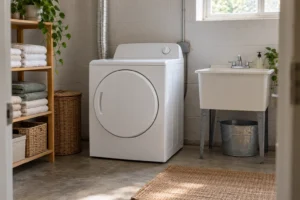
Dryers
Electric and gas Kenmore dryers we service in San Francisco, with label tips, no-heat and drum faults, vent checks and a clear…

Specialized Kenmore Appliance Repair in San Francisco
Mon–Sat: 8:00 AM – 7:00 PM
Electric or gas, stacked in a closet or standing alone in a garage, a Kenmore dryer gets a diagnosis first and a written estimate before any work.
Kenmore repair checklist · San Francisco Bay Area
A Kenmore dryer rarely fails in a mysterious way. It stops making heat, it stops turning the drum, it makes a sound it never used to make, or the clothes simply come out damp. Each of those symptoms leads a technician down a different path, and the vent that carries moist air out of your building is part of every one of them. We repair Kenmore dryers in San Francisco flats, condos, row houses and in-law units, and in homes across the wider Bay Area, on both electric and gas models.
Nothing is repaired until the cause has been found, you have seen a written estimate, and you have said yes.
On an electric dryer this usually points to the heating circuit: the element, a thermal limit that has opened, or the control that feeds them. On a gas dryer it points to the ignition and gas valve side instead. See Kenmore dryer not heating.
Damp clothes after a full cycle often come from restricted airflow rather than a dead part. A packed lint path, a crushed duct behind the machine, or a roof or wall cap clogged outside will all trap moisture inside the drum. See Kenmore dryer takes too long.
If the drum will not rotate, the belt, the idler pulley, the motor and the door switch are the suspects. A dryer that will not start at all can also be waiting on a door switch or a start switch that no longer registers. See Kenmore dryer not tumbling.
A steady squeal usually comes from a worn pulley, roller or bearing, while a rhythmic thump suggests a flat spot on a roller or a belt that has taken a set. See Kenmore dryer squeaking noise.
Dryers protect themselves. A high-limit thermostat or thermal fuse will cut heat, or the whole machine, when the air inside gets too hot, and the usual reason for that is poor airflow. Replacing the protective part without finding what overheated it only delays the next failure.
Before we touch anything we confirm which kind of dryer you have, because the diagnostic path is different. An electric dryer needs a healthy supply at the outlet and a working heating element and its safeties. A gas dryer also needs gas supply to the machine, an igniter that glows properly, and valve coils that open when asked.
We cover a Kenmore Elite gas dryer, 796.90512900, which is no longer sold new, along with several current electric units such as 26-69162 and the compact 26-81202. If your label matches one of them, the model page lists what we know about it.
Bay Area buildings are full of dryer vents that were never ideal. Older flats may run a duct up through a light well or along a hallway to an exterior wall, and the longer or more bent the run, the more lint it holds. A hose squashed behind the dryer can close almost completely. On a gas dryer a blocked vent is also a combustion concern, not just a drying one.
During a visit we look at how the duct leaves the machine, whether it is crushed or sagging, and whether the exterior flap opens freely. In tight closets, tell us ahead of time how much room there is to slide the unit out.
Many San Francisco dryers sit in a hallway closet, under a counter, or in a shared basement laundry. A closet door that stays shut during a cycle can starve the dryer of air. Stacked units add another wrinkle: the dryer on top is held by brackets or a stacking kit, and getting at the back panel may mean lifting or moving it with care.
Most Kenmore dryers give you very little to read: a light, a cycle indicator, sometimes a short message. We do not have separate code pages for dryers, so we will not guess at a meaning. What does help is writing down exactly what the display or the lights do and when. For Kenmore ranges, wall ovens and cooktops the code pages are indexed in the error codes page.
Leave the back panel, the burner area and anything electrical alone. Those jobs belong to a technician.
Turn the dryer off at the breaker and leave it off if you smell something burning, see sparks, find scorched lint, or if the cabinet feels unusually hot. On a gas dryer, if you smell gas, leave the home straight away, do not touch any light switches, and call the gas utility or 911 from outside.
Belts, rollers, igniters, thermal parts and switches differ from one Kenmore dryer to another. The complete model number is what lets us match them, and it is usually printed on a label inside the dryer door opening. A photo of that label, the vent setup and a short note of what the dryer does or does not do all help the first conversation. Many Kenmore dryers in local homes are older units, so the label is the reliable way to tell what you have.
The Kenmore dryers guide describes the lineup and where to find your label. If a washer shares the space, the Kenmore washer repair page covers the other half of the laundry pair. Not sure whether a dryer is worth fixing? Read repair or replace a Kenmore appliance.
Electric dryers usually lose heat because of a failed element, an opened thermal part, or a control that is not sending power. Gas dryers more often have an igniter or valve issue. The technician tests which applies before recommending a part.
Yes. Trapped heat makes thermal protectors trip, shortens the life of the element or burner, and keeps clothes wet. It also increases the chance of a lint fire, which is why we look at the vent on nearly every call.
Yes, both. We confirm the fuel type first because the checks differ, and for a gas dryer we also confirm that the venting is clear.
It changes access. The dryer may need to be lifted or slid with care, and the washer hoses and floor need protecting. Let us know it is stacked when you book.
The model number from the label, a description of what the dryer does, whether it is gas or electric, and notes on the vent route and how much clearance you have around the machine.
Electric and gas Kenmore dryers we service in San Francisco, with label tips, no-heat and drum faults, vent checks and a clear…
Kenmore cooktop repair in San Francisco and the Bay Area: gas burners that will not light, electric and induction elements that stay…
Standing water, dirty dishes, leaks and no-start problems on Kenmore dishwashers, checked from the drain path and the door latch through to…
Chest and upright Kenmore freezers that stop freezing, ice over or run nonstop, diagnosed in garages, closets and kitchens around the Bay…
Diagnosis and repair for Kenmore countertop, over-the-range and built-in microwaves across San Francisco and the Bay Area, with a written estimate first.
Share a few details and we’ll confirm an appointment. Prefer to talk? Call us and we’ll help right away.