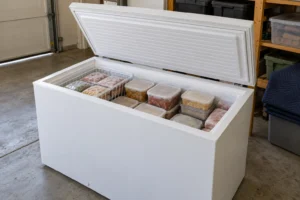
Freezers
Kenmore freezers we service in San Francisco and the Bay Area: model labels, frost and warm-freezer faults, display codes and safe checks…

Specialized Kenmore Appliance Repair in San Francisco
Mon–Sat: 8:00 AM – 7:00 PM
Food is at stake when a freezer fails. We diagnose first, explain the cause in writing, and repair only with your approval.
Kenmore repair checklist · San Francisco Bay Area
A freezer does its job quietly in a garage, basement, pantry or kitchen corner until the day someone opens the lid and finds soft ice cream. Kenmore chest and upright freezers are common in Bay Area homes, often as the second cold appliance in a household where the main refrigerator is too small. Because the real loss is the food inside, it helps to know what the early signs look like and what to do in the first hour.
Ice on the top of the packages is a hint, as is a lid that feels cool rather than cold. Common causes include a dusty condenser, a fan that has stopped, a door or lid gasket that no longer seals, and a temperature control or sensor that reads incorrectly. The sealed cooling system sits behind all of these, but we rule out the simpler items before looking toward it.
Silence usually means a power problem first: a tripped breaker, a loose plug, a power strip that was switched off while vacuuming. If power is present, the start components, control or compressor come next. A garage outlet that shares a GFCI with outdoor fixtures is a frequent culprit, since a damp morning can trip it unnoticed.
A manual-defrost chest freezer builds frost slowly as the door is opened, but thick ice on the walls, a lid that will not close, or ice that returns within days points to a gasket leak or moist air getting in. Upright models with automatic defrost can also fail in the defrost heater, sensor or timer, covered in our freezer frost build-up article.
A compressor that never seems to cycle off is working hard against something: warm room air, a dirty condenser, a door that is slightly open, or a sealed-system loss. Rattles often come from a fan blade or a loose drip tray.
Meltwater from a frost cycle, a blocked drain, or a power loss that thawed the contents is the usual source.
Freezers with an electronic control show codes when the control sees a problem. For deluxe electronic-control freestanding freezers, the code pages have d for a door that is ajar, CE for a communication error between the control panel and the electronic control board, and E for a control system error. Freezers with an electronic control also use E7 for a stuck key and E8 or E9 for a defective thermistor. Note the code exactly. It narrows the circuit; it does not name the part.
Do not chip ice with a knife or screwdriver, pull panels, or heat the walls with a hair dryer on the inside. A punctured liner or tube is hard to repair and may leak refrigerant.
Keep the lid closed. A full freezer holds cold longer than a half-empty one. If the unit has failed, move food to a neighbor’s freezer or coolers with ice as soon as you can, and avoid refreezing items that have thawed fully. Tell us how long the freezer was off, which helps decide how urgent the visit is.
Unplug the freezer or turn off its breaker for a burning smell, buzzing from the electrical area, melted plastic near the plug or a cord that feels hot. Do not keep using a unit that trips the breaker over and over.
The label on a freezer is usually on the inner wall, near the top rim or behind the lid hinge. It lists the model number needed for control boards, sensors, fans, gaskets and compressor parts. Without it we may have to guess between similar cabinets. Pages for models seen here include Kenmore 253.16342 and Kenmore 253.28042. The Kenmore freezer guide shows more.
We ask what you noticed, how long the unit has been warm, and whether it is in a garage or kitchen. Then we check power, temperature control, gaskets, fans, defrost components and the sealed-system start parts. After the diagnosis you receive a written estimate, and no repair begins until you agree to it. If the freezer is better retired than repaired, we tell you.
When it is a freezer that sits behind the refrigerator or inside a closet, mention any items that must be moved. If you are comparing a fault in the main fridge, see Kenmore refrigerator repair. A symptom-first article is Kenmore freezer not freezing.
It may be fighting a poor door seal, a dirty condenser, a warm room or a cooling fault. Check the gasket and the dust first, then book a diagnosis if it keeps running without getting cold.
That depends on how full it is and how often the lid is opened. Keep it shut, move food to coolers if the freezer will stay off, and discard anything that has thawed and warmed.
Some build-up is normal on manual-defrost models. Thick ice, a lid that no longer closes or frost that returns quickly is not, and suggests a seal or defrost problem.
Usually yes. Clear a path to it and make sure there is light and an outlet nearby. If it must be moved, tell us before the visit.
The model number from the label, the symptom, how long it has been warm, and any code on the display.
Kenmore freezers we service in San Francisco and the Bay Area: model labels, frost and warm-freezer faults, display codes and safe checks…
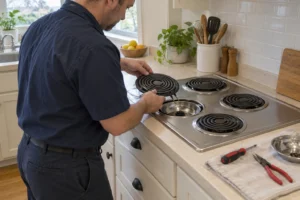
Kenmore cooktop repair in San Francisco and the Bay Area: gas burners that will not light, electric and induction elements that stay…
Standing water, dirty dishes, leaks and no-start problems on Kenmore dishwashers, checked from the drain path and the door latch through to…
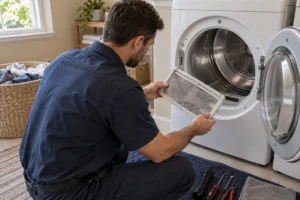
Kenmore dryer repair in San Francisco and the Bay Area for electric and gas units: no heat, long dry times, no tumble,…
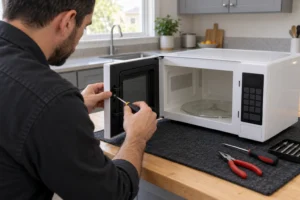
Diagnosis and repair for Kenmore countertop, over-the-range and built-in microwaves across San Francisco and the Bay Area, with a written estimate first.
Share a few details and we’ll confirm an appointment. Prefer to talk? Call us and we’ll help right away.