

Specialized Kenmore Appliance Repair in San Francisco
Mon–Sat: 8:00 AM – 7:00 PM
If your Kenmore dishwasher does nothing when you press Start, the cause is often power, the door latch or a lock setting. Work through the checks in this order.
Kenmore repair checklist · San Francisco Bay Area
You loaded the dishes, pushed the door shut, pressed Start, and nothing happened. No water, no hum, or maybe a click and then silence. A Kenmore dishwasher that will not start is one of the more irritating calls, because the fault could be as simple as a tripped outlet or as involved as a control board, and the machine does not announce which. What it does give you is behavior, and behavior is a good guide.
Sort your dishwasher into one of four groups. Completely dead means no lights and no sound. Lights on but no response means the panel wakes up but pressing Start does nothing. Humming without filling means the motor tries but no water comes in. Starts and then stops within moments means the cycle begins and aborts. These four paths lead to different causes, so settle on one before you touch anything.
A dead panel usually means no power is reaching the control. Look at the breaker first, then any wall switch or outlet that serves the dishwasher. Many San Francisco kitchens wire the dishwasher into the same circuit as the garbage disposer or a GFCI outlet near the sink; if the disposer ran earlier and tripped something, the dishwasher can go dark with it. Press the test and reset buttons on the GFCI if there is one nearby.
If power is confirmed and the panel stays dark, the cause may be inside the unit: the door switch assembly, a thermal fuse on the control, or the control board itself. Those are technician territory.
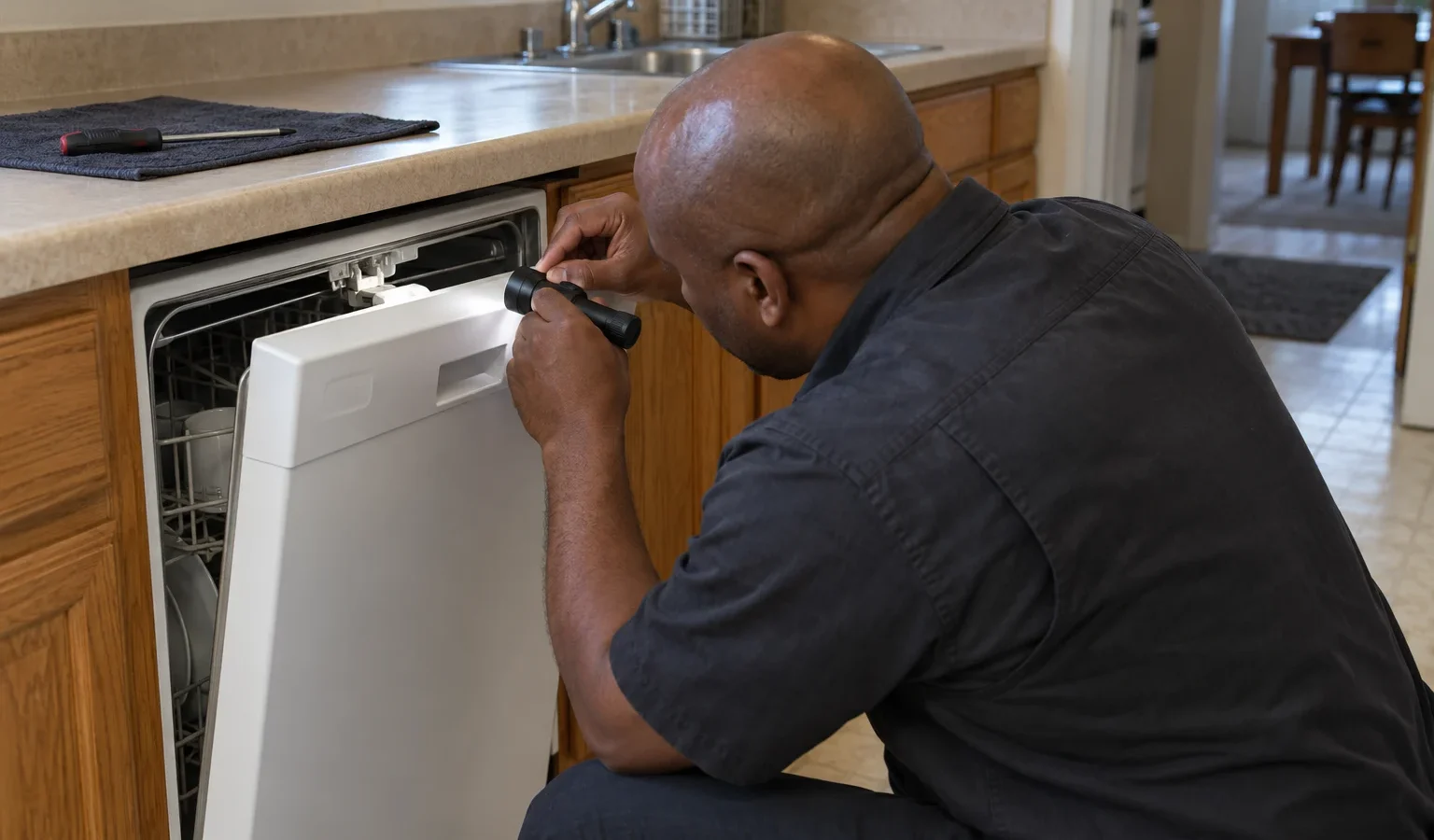
This is where the door matters most. The control will not begin a cycle unless it sees a closed, latched door, and the latch assembly wears with years of use. Close the door firmly and listen for a distinct click. If the click is weak or the door bounces back slightly, the latch or strike may be worn or something may be blocking the door, such as a rack that is not fully pushed in or a dish handle sticking out.
Then check for a control lock. Many Kenmore panels have a lock or child-lock setting that disables buttons without turning the lights off. A light or icon for the lock, or a message about a held button, is a clue. On some units a stuck button will also cause the control to refuse to start; the 665 models, for instance, flash the console light rapidly when they sense one. Press around the panel gently to feel whether any key stays depressed.
A hum with no water suggests the control did call for a cycle, and the dishwasher is waiting on something. The water supply valve under the sink may be partly or fully closed, the supply line may be pinched where it passes through the cabinet, or the inlet valve may be failing. You can check the first two from the outside. The inlet valve is not an owner repair. If a code appears, the IE code on units that use it means the dishwasher is not filling.
A dishwasher that begins and aborts is usually reacting to something it senses mid-start: a door that opens a hair, water that does not drain from a previous cycle, a float that sits high, or a leak sensor. Look in the tub. Standing water from the last load means the dishwasher may be holding itself back because of a drain problem, and our dishwasher not draining article follows that thread. Check also for suds, which can confuse the water-level sensing and are caused by using the wrong detergent.
Do not remove the lower kick panel to inspect wiring while the dishwasher is connected to power. Do not bridge switch contacts to see whether the control wakes up, and do not hit the control panel to dislodge a stuck key. A dishwasher is wired close to water, and amateur testing on a live unit is where small problems become dangerous ones. If you notice a burning smell from the area, switch off the breaker and leave it off.
Under-counter dishwashers in tight galley kitchens, which are common in the older flats around the city, are often pulled out only a little for service, and the electrical connection sits behind a small cover at the front lower corner. If a previous repair or a remodel left the dishwasher pushed against its wiring, a loose connection can interrupt power intermittently. A dishwasher that starts only when you press on the door or lean on the unit is describing exactly that. Mention it when you book.
Also note whether the dishwasher shares a plug with a disposer and how the drain hose is routed, because hose loops and air gaps affect drain faults that can block a start.
Book a visit if the checks above do not restore a start, if the unit is dead with confirmed power, if it clicks but stays silent, or if a code appears that you cannot clear. The technician will diagnose before repairing, give you a written estimate, and do nothing without your approval. Have the full model number ready from the label, normally on the tub rim or inside the door edge. The service details are on our Kenmore dishwasher repair page, and the Kenmore dishwasher guide shows the lineup we see. A current example is the 22-14582; older units like the 587.1625 turn up often in rentals.
A click usually means the control tried to start something and a relay or switch did not complete the job. Door latch wear, a lock setting and a stuck panel key are the owner-level checks; if they change nothing, a technician should look at the latch assembly and control.
In many kitchens the two share a circuit or an outlet, so a tripped breaker or GFCI that stopped the disposer can also cut power to the dishwasher. Reset the GFCI and confirm the breaker before assuming a fault.
A sudden stop often points to power, the latch or a lock setting, since those can change overnight. Parts that wear slowly, like control boards, can also fail without warning, so if the checks come up clean, book a diagnosis.
It is a sign of a worn latch or loose connection, and repeated forcing can make it worse. Stop relying on that workaround and have the door switch and wiring checked.
Not before diagnosis. Many start failures come from a latch, switch or inlet issue that is far smaller than a replacement. Ask for the written estimate, then compare it to the unit’s age and condition.
Share a few details and we’ll confirm an appointment. Prefer to talk? Call us and we’ll help right away.