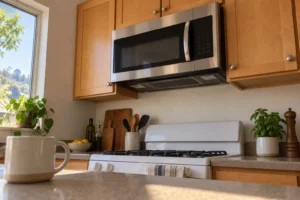
Microwaves
Countertop and over-the-range Kenmore microwaves in San Francisco: no-heat faults, turntable and door problems, label tips and safe checks.

Specialized Kenmore Appliance Repair in San Francisco
Mon–Sat: 8:00 AM – 7:00 PM
Countertop, over-the-range and built-in microwaves, diagnosed before anything is repaired.
Kenmore repair checklist · San Francisco Bay Area
A microwave is the appliance in a San Francisco kitchen that never gets a day off. It reheats coffee in a narrow galley, thaws dinner in a studio with a two-burner stove, and sits above the range in countless Bay Area flats. When a Kenmore microwave stops working, the whole morning routine suffers. Our Kenmore microwave repair service covers countertop, over-the-range and built-in units, and starts with a diagnosis rather than a guess.
Most complaints fall into a few groups, and the group tells a technician where to start.
The light comes on, the turntable spins, the fan hums, and the plate is exactly as cold as when it went in. That points away from the controls and toward the heating circuit, which is made of several parts that all have to work together. Because some of those parts hold dangerous stored energy even when the unit is unplugged, this is never a do-it-yourself repair. Our article on a Kenmore microwave not heating walks through what the symptom usually means before you book.
A blank display or unresponsive buttons can come from a control board, a keypad, a door switch or the outlet. A technician tests them in order.
The door on a microwave is not just a cover. It works with latches and switches that tell the unit when it is safe to run. If the door has to be slammed to start a cycle, hangs crooked, or pops open, a broken latch hook or a worn hinge is likely. Do not keep forcing it. A door that does not seal flat is a reason to stop using the unit until it is checked.
A grinding or rattling sound often comes from the turntable support or the drive motor. Arcing inside the cavity can come from a damaged interior coating, a metal item left in by mistake, or a failed cover over the wave opening. A burning smell is different. Switch the unit off at the breaker and leave it off.
An over-the-range microwave also acts as a hood for the cooktop below. The fan may run weakly, the light may go dark, or the grease filter may be so clogged that airflow drops. Those faults sit in a different part of the unit than the heating system, so they are diagnosed separately.
We confirm the symptom with you first, then check the power supply, the outlet and the way the unit is installed. Next the technician tests the door system, because a microwave that believes its door is open will refuse to heat at all. After that, the heating circuit and the control side are examined in a safe order, with the unit discharged where required. You get a written estimate with the cause identified. Nothing is repaired until you approve it, and if the repair does not make sense for a given unit, we say so.
Where the microwave lives shapes what can go wrong.
Stay on the outside of the unit. These are reasonable first steps before you request a visit:
Do not remove the outer cover, touch anything inside the cabinet, or test any circuit. The internal parts of a microwave can hold a dangerous charge.
Switch the unit off at the breaker and do not use it again until it has been checked if you see sparks, smell burning, notice smoke, find a door that no longer closes flat, or see damage to the cord.
Kenmore microwaves are common in Bay Area rentals and family homes, and many are older units that have been in daily use for years. Parts for a latch assembly, a control board or a turntable motor differ from one model to the next, even when two units look alike from the front. The full model number is usually on the cavity wall, on the door frame or behind the door. On an over-the-range unit it can also appear on the side edge.
You tell us the symptom and the model number when you request a visit. The technician arrives, looks at the installation, checks the power and door system first, and works through the diagnosis. You see a written estimate. After you approve it, the repair is carried out, and the unit is tested before the technician leaves. If a part must be ordered, we explain what is needed and when we will come back.
If you are comparing your unit with others, our Kenmore microwaves guide describes the lineup and where to find the label. Specific unit pages include Kenmore 22-83383 repair for an over-the-range convection model, Kenmore KMCMB809BK09 repair for a countertop unit, and Kenmore 22-87062 repair. The symptom article on a Kenmore microwave not heating is a good companion read. To compare other kitchen appliances, see our Kenmore range hood repair page or go back to the full services list.
Usually the unit is not dangerous in that state, but it is not doing its job, and running it empty or with a tiny load is a poor idea. If you notice sparking, a burning smell, or a door that no longer closes flat, stop using it and switch it off at the breaker. A technician can then tell whether the fault is in the heating circuit or in the door.
The fan and the heating system are separate circuits, so a noisy fan does not mean the heating has failed, and the reverse is also true. A technician checks both during diagnosis, since a worn fan motor and a heating fault can show up in the same unit. You receive a written estimate that lists what is needed before any work begins.
Yes. A built-in or over-the-range unit is harder to read once it is installed, but the label is usually on the cavity wall or the door frame. Photographing it with your phone before the visit saves time, because part numbers differ between units that look nearly identical from the front.
We look at Kenmore countertop, over-the-range and built-in microwaves. Countertop units have a smaller footprint, but they still have a door latch system, a control board and a heating circuit that can fail. The diagnosis is done first, and you decide whether the repair makes sense for that particular unit.
Have the full model number from the label, a short description of what the microwave does or does not do, and a note about whether it is a countertop, over-the-range or built-in installation. If the display shows a message, write it down exactly. Tell us about any recent power outage, breaker trip or move, since those often explain a sudden failure.
Countertop and over-the-range Kenmore microwaves in San Francisco: no-heat faults, turntable and door problems, label tips and safe checks.
Kenmore cooktop repair in San Francisco and the Bay Area: gas burners that will not light, electric and induction elements that stay…
Standing water, dirty dishes, leaks and no-start problems on Kenmore dishwashers, checked from the drain path and the door latch through to…
Kenmore dryer repair in San Francisco and the Bay Area for electric and gas units: no heat, long dry times, no tumble,…
Chest and upright Kenmore freezers that stop freezing, ice over or run nonstop, diagnosed in garages, closets and kitchens around the Bay…
Share a few details and we’ll confirm an appointment. Prefer to talk? Call us and we’ll help right away.