Refrigerators
Top-freezer, bottom-freezer, French-door, side-by-side, compact and beverage Kenmore refrigerators we service in San Francisco, with common faults and safe checks.

Specialized Kenmore Appliance Repair in San Francisco
Mon–Sat: 8:00 AM – 7:00 PM
Your Kenmore refrigerator is warm, frosting up, leaking or loud. We find the cause first and tell you in writing before anything is repaired.
Kenmore repair checklist · San Francisco Bay Area
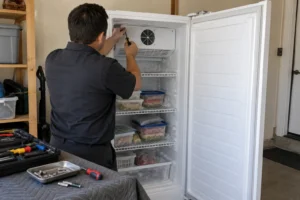
A Kenmore refrigerator rarely fails all at once. It usually starts with a small change: a fresh-food shelf that feels cooler at the front than the back, milk that turns a day early, a hum that never seems to stop, frost on the freezer wall, or a damp patch spreading across the kitchen floor. In San Francisco kitchens, where the refrigerator often sits in a narrow alcove between cabinets and a wall, those early signs are easy to miss until the freezer thaws. This guide covers what we look at on Kenmore top-freezer, bottom-freezer, French-door and side-by-side refrigerators, plus compact units and beverage centers.
When the freezer holds but the fresh-food side drifts warm, the usual suspect is airflow. Cold air is made in the freezer and sent to the food compartment through a duct and a damper. A frosted-over evaporator, a stuck damper, a failed evaporator fan or a blocked vent behind the back panel can all starve the fresh-food side. A technician follows the air path rather than guessing at the sealed system.
If both compartments warm up, we separate cooling-system problems from control problems. A condenser fan that has stopped, a coil clogged with dust, a start relay, a temperature control or a main board can each produce the same complaint. The fix differs for each, which is why a measured diagnosis comes before any part is ordered.
Heavy frost on the freezer back wall points to the defrost system: the heater, the sensor that tells the control when to defrost, or the control itself. Water pooling under the crisper drawers or at the front grille often means the defrost drain is frozen or clogged and melt water has nowhere to go.
A rattle, a buzz or a fan that rises and falls each has a different source; our refrigerator noise guide lists what each sound tends to mean.
Water under a refrigerator comes from a handful of places: the defrost drain, the water inlet valve, a loose fitting on the supply line, the ice maker fill tube or the dispenser tank. Matching the puddle to its source saves a lot of dismantling. See also why a Kenmore refrigerator leaks water.
No ice, small or hollow cubes, a dispenser that dribbles or a filter light that will not clear usually trace back to the water supply, the filter housing, the inlet valve or the ice maker module. The ice maker troubleshooting article goes through them in order.
Many Kenmore refrigerators with an electronic control show a short code when a sensor, fan or heater circuit reports a fault. Write the code down exactly, including capital and lowercase letters, before you do anything else. Examples from the code pages on this site include Er FF for an evaporator fan failure, Er CF for a condenser fan motor, F3 for a freezer defrost heater failure, r3 for the refrigerator defrost heater, and d for a stuck air damper. A single code names the circuit that reported a problem; it does not prove which part is bad, because wiring and boards sit in the same circuit. More are collected in our error codes page and in the refrigerator error codes article.
The kitchen around the refrigerator matters as much as the refrigerator. Many San Francisco flats and older row houses have cabinets built tight around the opening, leaving little space behind or above the cabinet. A condenser that cannot shed heat will run constantly and cool poorly, and the fix may be clearance and cleaning rather than a part.
These all happen from the outside and take a few minutes:
Do not pull off back panels, scrape frost with metal tools, or touch the sealed tubing and compressor area.
Shut the unit off at the breaker if you smell something burning, hear loud electrical sounds, or see scorching near the outlet. Move food to a cooler if the compartments cannot hold temperature, and keep doors closed to slow warming. If water is reaching a floor outlet or running under flooring in a unit above another apartment, close the supply valve and request a visit promptly.
Kenmore has sold many refrigerators over the years, and many of them are still working in Bay Area kitchens. Fan assemblies, defrost heaters, control boards and ice makers vary between them, even when the doors look identical. The label usually sits on the inside wall of the fresh-food compartment, near the top corner or along the door frame. A photo of that label and the code you wrote down helps us bring the right parts and avoid a second trip. Our model pages includes pages such as Kenmore 46-75525 and Kenmore 46-61332.
We start with the symptom and the history: when it began, what changed in the kitchen, whether the ice maker or water line is involved. Then we check airflow, fans, defrost components, door seals and the control, working from the easiest to the hardest to reach. You get a written estimate with the cause we found before any repair starts, and nothing is repaired without your approval. If the answer is that the unit is better replaced, we say so plainly.
For the lineup, see Kenmore refrigerators. For troubleshooting before you book, read Kenmore refrigerator not cooling. A separate chest or upright freezer is covered under Kenmore freezer repair.
Often it is not. That pattern commonly comes from an airflow or defrost issue, such as a frosted evaporator or a fan that is not moving cold air into the food compartment. We check those first before anyone discusses the sealed system.
If the freezer is still solid and the fresh-food side is only slightly warm, keep the doors closed and watch it. If food is warming through, move perishables into a cooler and tell us when you book.
The defrost drain may be frozen or blocked, so melt water spills into the compartment instead of draining to the pan. A technician clears the drain and looks for the reason the freezer is icing in the first place.
Yes. Many older units are still in daily use around the city. Send the full model number from the label and we will check what the unit needs before the visit.
The model number, the symptom and when it began, any display code written exactly, and a note about stairs, parking or building access.
Top-freezer, bottom-freezer, French-door, side-by-side, compact and beverage Kenmore refrigerators we service in San Francisco, with common faults and safe checks.
Kenmore cooktop repair in San Francisco and the Bay Area: gas burners that will not light, electric and induction elements that stay…
Standing water, dirty dishes, leaks and no-start problems on Kenmore dishwashers, checked from the drain path and the door latch through to…
Kenmore dryer repair in San Francisco and the Bay Area for electric and gas units: no heat, long dry times, no tumble,…
Chest and upright Kenmore freezers that stop freezing, ice over or run nonstop, diagnosed in garages, closets and kitchens around the Bay…
Share a few details and we’ll confirm an appointment. Prefer to talk? Call us and we’ll help right away.