

Specialized Kenmore Appliance Repair in San Francisco
Mon–Sat: 8:00 AM – 7:00 PM
Buzzing, clicking, rattling or a loud hum from your Kenmore refrigerator? Match the sound to its likely source and learn which noises are normal.
Kenmore repair checklist · San Francisco Bay Area
In a quiet flat or a small studio the refrigerator is the one appliance you hear all night. A new sound from your Kenmore is easy to notice and hard to ignore, but it does not always mean trouble. Some noises belong to normal operation, while others come early in the life of a failing fan or compressor part. Listening closely and noting when the sound happens will do most of the diagnostic work before a technician arrives.
If the sound is brief, repeats on a rhythm and your food is cold, there is usually nothing to fix.
The common cause is something simple: a loose drain pan under the cabinet, a leg that is not touching an uneven floor, or the cabinet resting on a wall or neighboring cabinet. Older San Francisco buildings have floors that slope, and a refrigerator that sits unevenly will hum through the whole kitchen. Check that the front legs are firm and that the cabinet is not touching anything. If the rattle stays, the condenser fan blades or the motor mount may have loosened.
A harsh buzz often comes from a fan struggling against ice or debris, or from a compressor that is working hard to start. If it comes with warm food, treat it as a fault, not a quirk.
Dry bearings in a fan motor produce a high note that rises and falls with the fan. The freezer evaporator fan is a frequent source, particularly when frost has built up around its blades. Some displays then show a fault; the meaning of an evaporator fan failure code is on its own page.
Ice pressing against the fan, or a blade touching the housing, makes a rough sound that often goes away after the door has been open a while and returns later. It usually points to a defrost problem that lets frost accumulate, and it tends to be followed by poor cooling.
A relay that clicks repeatedly without the compressor settling can mean a failing start component or a control that is repeatedly trying to start the system. Because this repeats, it is worth a diagnosis before it leads to a failed compressor.
The ice maker cycles on its own schedule: a motor turns, the ice drops, the fill valve opens. A knock or thud at those moments is typical. If the thud is loud or the cycle seems stuck, see the ice maker troubleshooting article.
Thin floors, hardwood over a crawlspace and open-plan studios carry sound farther than a closed kitchen would. A refrigerator that was silent in a house can seem to roar in a flat above a garage. Felt pads or a firmer footing under the legs sometimes help, but they do not cure a failing fan, so treat a rising pitch as information, not just irritation.
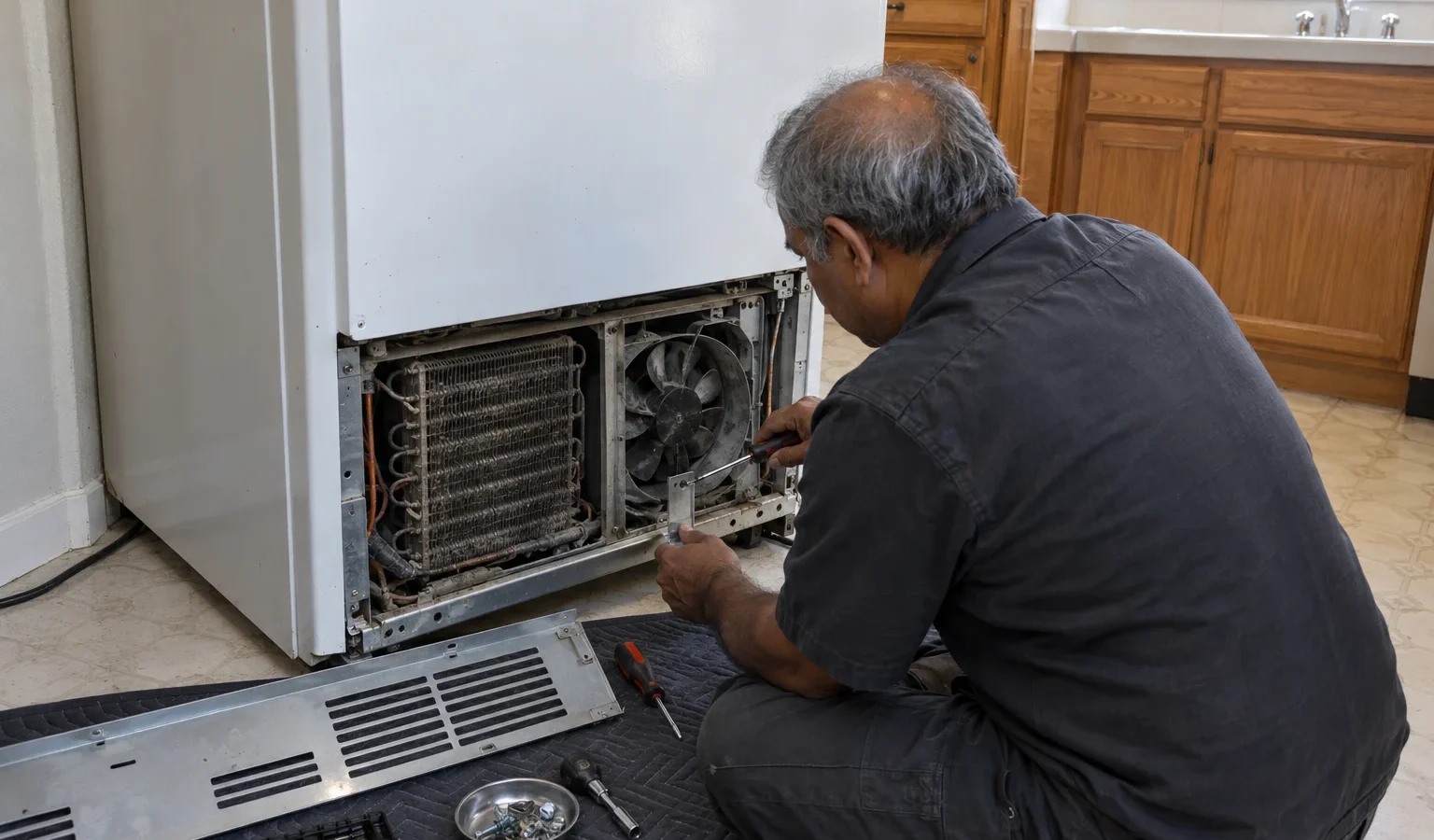
Do not remove back panels or pull the cover off the compressor area. Do not spray lubricant into fan motors, and do not keep running a unit that smells of burning or sparks: switch it off at the breaker. Fan bearings and compressor parts need a technician.
A new noise paired with warm food, constant running, frost on the back wall of the freezer or a burning smell is a different situation from a rattle on a wobbly floor. A fan noise that is growing louder over a few weeks tends to end in a stopped fan, and a stopped fan means a warm refrigerator. If you recognize this, read our guide to a Kenmore refrigerator not cooling and arrange a visit.
Our Kenmore refrigerator repair service begins with diagnosis. You receive a written estimate and nothing is repaired until you approve it. Have the full model number ready; it is usually on the inside wall of the compartment or along the door frame, and it helps us bring the right fan or motor. You can browse the Kenmore refrigerators we service or see how a top-freezer entry such as the 46-61332 is described.
A steady low hum that cycles on and off is normal while the compressor runs. A hum that never stops, gets louder or comes with warm food deserves a diagnosis.
The house is quieter, so you notice sounds that were always there. Loose legs, a drain pan or contact with a wall are typical. Level the cabinet and check what it touches.
Often a fan motor with dry or worn bearings, sometimes made worse by frost around the blades. It tends to get worse, so schedule a check before the fan stops.
If the cabinet touches a wall or cabinet, giving it room can quiet it. Move it carefully, keep the water line unkinked and leave space for air around the coils.
Not necessarily. Fans, the ice maker and loose parts are more common sources. A technician finds the real source before suggesting any larger repair.
Share a few details and we’ll confirm an appointment. Prefer to talk? Call us and we’ll help right away.