

Specialized Kenmore Appliance Repair in San Francisco
Mon–Sat: 8:00 AM – 7:00 PM
Soft ice cream, thawing packages or a chest freezer that hums but never gets cold: the usual reasons a Kenmore freezer stops freezing and how to sort them out.
Kenmore repair checklist · San Francisco Bay Area
When a freezer stops freezing, the first sign is often small: ice cream that scoops too easily, a bag of peas that has softened, frost that looks wet. By the time everything is soft, the loss is already underway. Chest and upright freezers share the same basic principle, so most causes fall into a handful of groups, and the order in which you check them matters more than speed.
Freezers in garages, utility rooms and basements are often on a circuit shared with tools, or on a GFCI outlet that trips quietly. A cord that was nudged out of the wall by a broom or a moving box is just as common. Look for a light or display, listen for the compressor and check the breaker and the outlet. A trip-prone GFCI is a sign to stop and have the circuit looked at, not to keep resetting it.
A freezer in a hot space, packed tightly against a wall, or with a door that does not seal, will run and run without reaching its target. Common culprits are a lid or door gasket that has gone wavy, a lid that does not sit flat because items stick out, and frequent door openings. In San Francisco garages the problem is less about heat and more about dust, cardboard and stored items that press against the cabinet and block air.
Condenser coils covered in dust cannot shed heat, and an upright freezer with a blocked fan grille starves the evaporator of air. If the grille at the bottom lifts off easily, you can vacuum visible dust. Do not open sealed panels.
In frost-free uprights, a failed defrost heater, sensor or timer lets ice build over the coil. The unit hums but the air it moves is no longer cold. Typical signs are a thick white layer at the back and a freezer that is cold for a while after a manual defrost and then fails again. Our article on frost buildup in a Kenmore freezer covers it in detail.
If a fan stops or a thermistor reads wrong, the control can run the cooling at the wrong time. Displays may show a thermistor fault or a control system error, and a door-ajar code reports a door that is not closed. The meanings are listed on their pages.
If the compressor tries to start and clicks without running, a start component or the compressor itself may be at fault. Leaks in the refrigerant circuit also cause a slow loss of cooling. These are technician-only repairs and are diagnosed after the simpler causes are ruled out.
Keep the lid or door shut. A full freezer holds its cold for a long time, while a half-empty one warms faster. If a neighbor, a family member or a rental building has another freezer, move the most valuable items while they are still hard. Food that has thawed and refrozen should be judged carefully; when you are unsure about meat or seafood, discard it.
Do not defrost with a knife or heat gun, because the liner and the coil tubing are easy to puncture. Do not tamper with the thermostat wiring or bypass a switch. If you smell burning or hear crackling, shut off the breaker.
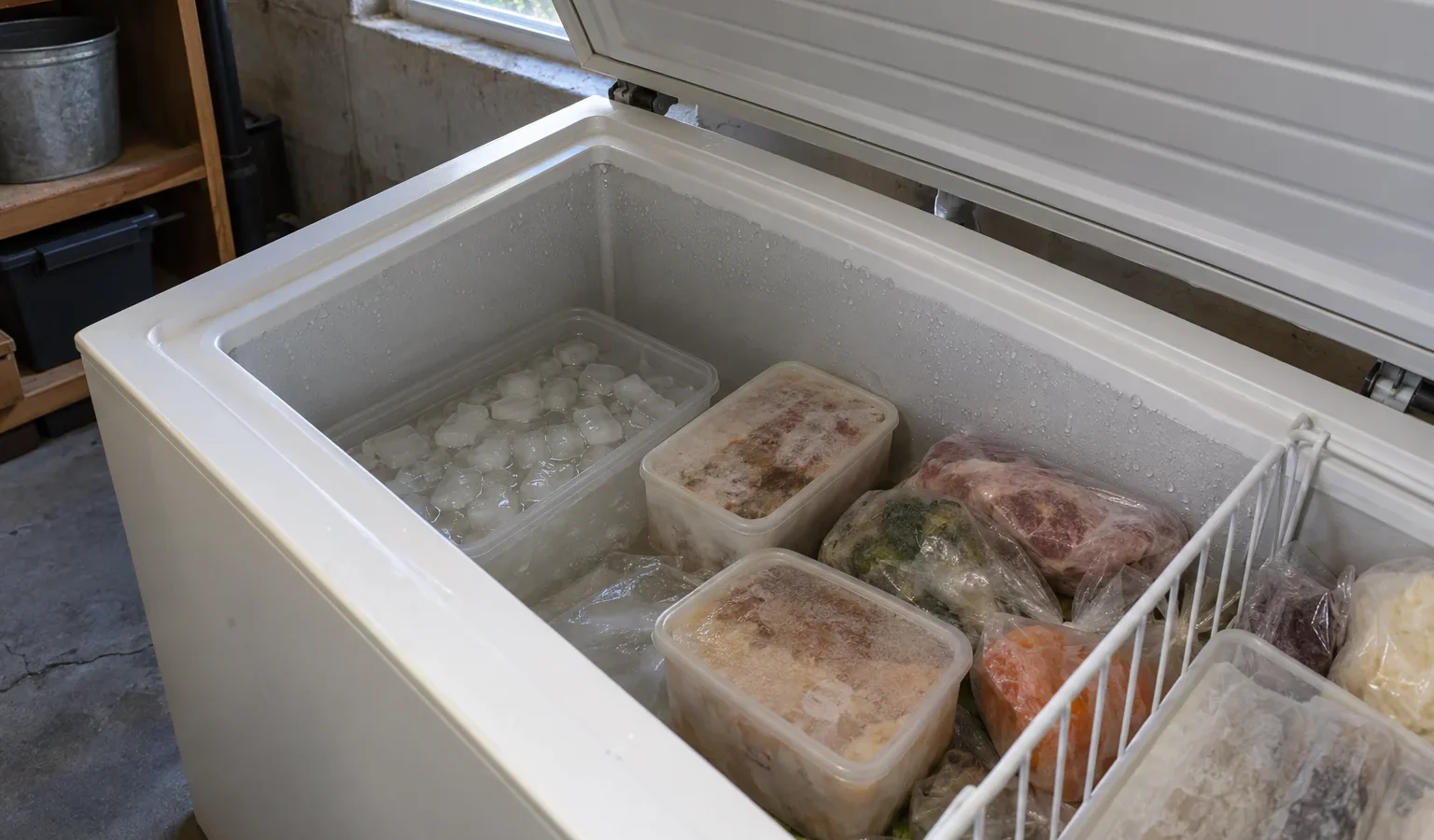
An upright freezer has shelves, a door and often a frost-free system, so airflow and defrost parts matter. A chest freezer is a simpler box with a manual defrost in many cases, so the lid seal, the thermostat and the compressor circuit are the main suspects. Either one in a San Francisco garage may share space with paint, boxes and bikes; leaving a gap around the cabinet gives the coils a chance to shed heat. Tell us which style you have, since the diagnosis starts differently.
San Francisco neighborhoods see short outages. A freezer that was not opened during the outage usually keeps its cold, but a unit that does not restart afterwards, or a breaker that will not stay on, needs checking before the contents warm.
Book when power and airflow check out but the freezer still will not freeze, when it hums without cooling, when it clicks repeatedly, or when frost returns quickly. Our Kenmore freezer repair visit starts with diagnosis, then a written estimate; we repair nothing without your approval. Have the model number ready, usually on the inner wall or near the lid hinge. The range is described in Kenmore freezers, and a sample entry is 253.16342.
The compressor may be running while airflow, the thermostat or the sealed system fails to produce cold. Dirty coils and a poor lid seal are the simplest causes.
It depends on how full the freezer is and how often the lid is opened. Keep it shut, check the food regularly and discard anything that has thawed completely.
Dust, stored items pressed against the cabinet and a shared circuit that trips can all interfere. Give it space and a reliable outlet.
Letting it thaw with the door open and towels down is fine. Never chip ice with a sharp tool or use a heat gun.
A diagnosis tells you whether the fault is a simple part. We give a written estimate so you can decide.
Share a few details and we’ll confirm an appointment. Prefer to talk? Call us and we’ll help right away.