

Specialized Kenmore Appliance Repair in San Francisco
Mon–Sat: 8:00 AM – 7:00 PM
A gas burner that clicks without lighting is usually dirty, wet or misaligned, but a weak spark module or a gas supply problem can also be behind it. Start with these safe checks.
Kenmore repair checklist · San Francisco Bay Area
You turn the knob, hear the rapid ticking of the spark igniter, and no flame appears. Or one burner lights fine while its neighbor refuses. Each pattern points to a different cause, so watch what happens before you start guessing.
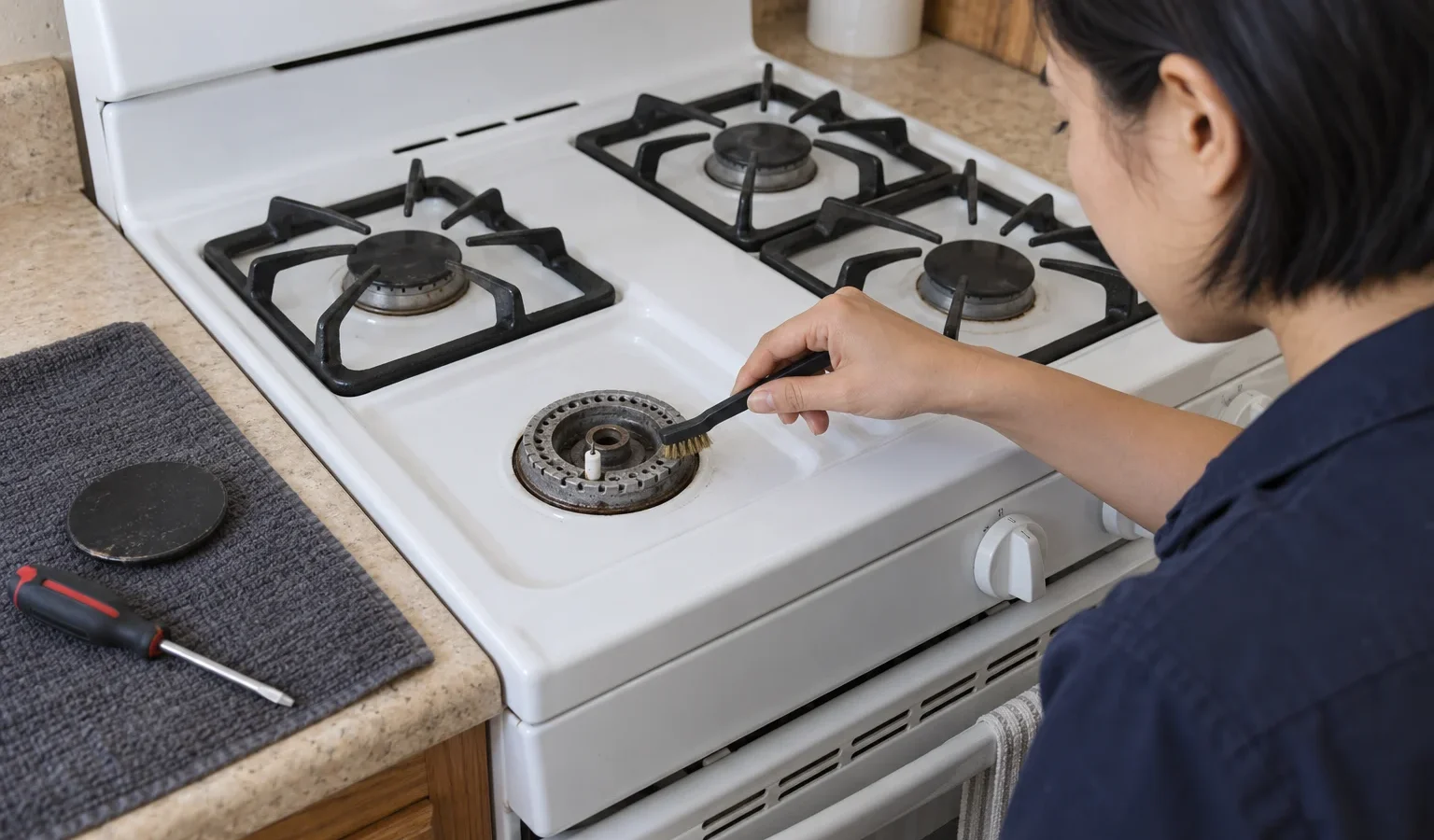
Gas burners rely on three things lining up at the same moment: a clear path for gas, a spark at the right spot, and a clean burner cap seated flat. Drop any one and the flame fails. If you ever smell gas while testing, turn the knob off, leave the room and call the gas utility or 911 from outside. Do not flip switches or look for the leak yourself.
This almost always means a local issue: food residue in the burner ports, a cap sitting crooked, moisture left after mopping a spill, or a worn spark electrode on that burner only. The gas supply and the spark module are shared, so they are less likely when only one position misbehaves.
Now suspect something shared. The gas valve behind the range may be partly closed after someone pulled the unit out to clean, a gas flex connector may be pinched, or the building supply may be interrupted. A shared spark module can also fail, though in that case you usually get no clicking at all.
If the spark keeps ticking while the burner is lit, a wet or dirty electrode is sensing the wrong thing, or the control is confused by moisture. Turn everything off and let it dry before trying again.
On a range with flame supervision, the burner needs to stay lit long enough to prove itself. Weak gas flow, a dirty port or a draft from an open window can interrupt that. San Francisco’s wind off the water makes the last one more common than people expect, especially in top-floor flats near a drafty window.
That is the end of the safe list. Anything under the cooktop surface is for a technician.
With the range off, look at the shutoff valve where the flexible gas line meets the wall or floor. The handle sits in line with the pipe when open. If the unit has been moved, check that the line is not kinked or crushed behind it. If you smell gas at all, do not test further; leave and call from outside.
Do not light a burner with a match while it clicks, do not spray cleaner into the igniter, and do not keep turning the knob in the hope it eventually catches, because gas builds up in the kitchen. Never open the cooktop surface, loosen gas fittings or bypass the ignition switch. In older San Francisco apartments the range is often wedged into a narrow gap, which makes any gas-side work hard to do safely without the proper tools.
If a thorough cleaning and a dry-out do not help, the next suspects are the spark electrode, the ignition switch under the knob, the module that creates the spark, or a clogged orifice. A diagnosis separates them in a single visit, you receive a written estimate, and nothing is repaired until you agree. Start with Kenmore range repair and see the Kenmore ranges overview for the types we service. If your burners sit in a built-in unit, the Kenmore cooktop burner guide covers the same symptom on a cooktop.
Most no-light calls start with a pot that boiled over. Sugary or starchy liquid dries into a crust that plugs the small ports, and a splash that reaches the electrode can ground out the spark. Wiping the cooktop right after it cools, and lifting the caps once in a while for a quick clean, prevents most of it. Cleaning products that leave a wet film on the cap can cause the same problem, so rinse with a damp cloth and let the parts dry before replacing them.
If you have recently moved the range, or someone has cleaned behind it, ask whether the caps were put back in the right positions. Large and small caps are not always interchangeable, and a cap placed on the wrong base will not light correctly.
Burner caps, electrodes and ignition switches differ by range, so the full model number matters. It is usually on the oven frame or inside a drawer. A compact unit such as the Kenmore 22-71942 repair entry, a 24-inch gas range, and the Kenmore 22-75293 repair entry both show how we organize parts by model.
The spark is firing, so the likely problems are blocked burner ports, a crooked cap, a wet or dirty electrode, or gas not reaching that burner. Cleaning and drying often solves it.
No. Repeated attempts let unburned gas collect around the cooktop. If it does not light in a few tries, turn it off, ventilate and troubleshoot instead.
A single dead burner points to that burner’s cap, ports or spark electrode. The gas supply and the shared spark module are less likely when the others work.
Turn the knob off, leave the home without touching switches, and call the gas utility or 911 from outside. Do not return until you are told it is safe.
We do not recommend it. If the igniter is failing, the same fault may affect the flame check, and the burner should be diagnosed before it is used regularly.
Share a few details and we’ll confirm an appointment. Prefer to talk? Call us and we’ll help right away.