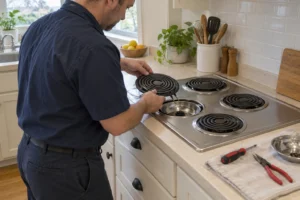
Cooktop Repair in San Francisco
Kenmore cooktop repair in San Francisco and the Bay Area: gas burners that will not light, electric and induction elements that stay…

Specialized Kenmore Appliance Repair in San Francisco
Mon–Sat: 8:00 AM – 7:00 PM
Find out what a dead burner or silent touch panel usually means and which checks are safe to try yourself.
Kenmore repair checklist · San Francisco Bay Area
A cooktop sits in a different spot from the rest of the kitchen: the controls are on the surface, the burners or elements are exposed to spills every day, and the working parts are tucked into a cabinet cutout below. Kenmore cooktops turn up in San Francisco flats, rental kitchens and family houses, often beside a Kenmore wall oven or refrigerator that has been in the same room for years. When one burner misbehaves, the whole cooking routine stops, so it helps to know what the symptom usually points to before you book a visit.
Kenmore cooktops come as gas, electric and induction. Gas units light a burner with a spark and need a steady gas supply plus a clean burner cap. Electric units heat a coil or a radiant element under glass. Induction units use a power board and touch keys to drive each cooking zone, and they report problems as numbers on the display. Among the models we cover, the cooktop is Kenmore 790.3050, a gas cooktop in the plain Kenmore series; we do not list its availability. Our error-code pages cover Kenmore induction cooktops. If your unit does not match any of these, send the full label number with the request and we will confirm what applies.
On a cooktop the label usually sits on the underside of the main body, so it is often out of sight once the unit is installed. Look for it on the edge of the cutout or on a flange under the surface only if it is visible without lifting anything. Write down the whole number, including dots and dashes, since a partial number can send a technician out with the wrong control or element.
Induction models show numeric codes that name a failed key, a sensor, or a board-to-board fault. For example, code 25 is the Power key, code 24 is the Lock key, and codes 51 to 54 name a temperature sensor at a specific element position. A lone H on an element that is cold means a temperature sensor fault. Open the matching page, such as Kenmore cooktop 25, Kenmore cooktop 51 or Kenmore cooktop H, and write the code down before you call. Power-related codes such as 30 and 35 point at supply voltage or internal wiring, which stays a job for a technician. The whole set is listed on the error codes hub.
If you smell gas, leave the home, avoid switches, and call the gas utility or 911 from outside. A burning smell, sparks or a cracked glass top means you should switch the power off at the breaker and stop using the cooktop.
A cooktop drops into a cabinet cutout, so the room underneath matters. Gas models rely on a shutoff, a flexible connector and a regulator, and a pinched connector can starve a burner. Electric and induction units depend on a dedicated circuit, and a loose connection at the junction shows up as a zone that flickers or a code about supply. A hood above carries steam and grease that settle on controls over time.
If the checks do not clear the problem, request a visit through Kenmore cooktop repair. We diagnose first, give you a written estimate, and repair nothing until you approve it. For a step-by-step on a single dead burner, read Kenmore cooktop burner not working.
A single clicking burner usually has a wet or dirty base, a cap that is not seated flat, or an igniter that is worn. Dry the burner, reseat the cap and try again. If it still will not light, a technician can test the igniter and the switch.
Yes. Our code pages cover Kenmore induction cooktops, where numbers name a key, a sensor or a control board problem. Write down the code and bring the full model number to the request.
Leave the home right away without using switches, then call the gas utility or 911 from outside. Do not relight anything until a technician has checked the unit.
No. Switch the power off at the breaker and stop using it, because liquid can reach the parts beneath the glass. A technician will tell you whether the top can be replaced.
It is usually on a label under the body or on the edge of the cutout, and sometimes only in the manual or installation papers. Photograph it if you can see it without lifting anything.
Kenmore cooktop repair in San Francisco and the Bay Area: gas burners that will not light, electric and induction elements that stay…
Kenmore dishwashers we repair in San Francisco: lineup, label location, leaks, drain and start problems, error codes and safe checks before you…
Electric and gas Kenmore dryers we service in San Francisco, with label tips, no-heat and drum faults, vent checks and a clear…
Kenmore freezers we service in San Francisco and the Bay Area: model labels, frost and warm-freezer faults, display codes and safe checks…
Countertop and over-the-range Kenmore microwaves in San Francisco: no-heat faults, turntable and door problems, label tips and safe checks.
Share a few details and we’ll confirm an appointment. Prefer to talk? Call us and we’ll help right away.