

Specialized Kenmore Appliance Repair in San Francisco
Mon–Sat: 8:00 AM – 7:00 PM
A washer with a full drum after the cycle has a blocked, kinked or failed drain path. Here is how to tell which, and what is safe for you to check.
Kenmore repair checklist · San Francisco Bay Area
You open the washer and the clothes are sitting in gray water. Maybe the cycle stopped mid-way, maybe it ended normally with the tub still full, and maybe it gurgles weakly and gives up. Water that will not leave a Kenmore washer is a problem with the drain path, and that path has only a few segments: the drum outlet, the pump, the drain hose, the standpipe and the house plumbing. The skill is working out which segment has failed, and doing it without making a mess.
Think of the drain as a chain. The tub empties into a pump, the pump pushes water into a hose, the hose runs up and over into a standpipe or a sink drain, and that connects to the building plumbing. Water can be stopped at any link. A clogged pump inlet, a kinked hose, a standpipe backed up from a blocked house line and a dead pump all produce the same view from the top: a full drum.
Listen when the washer tries to drain. A steady pump noise with no water leaving suggests a blockage past the pump, such as a collapsed hose or a clog in the standpipe. A loud rattling or rough noise suggests something hard, like a coin, a button or a hair clip, is caught in the pump. Silence suggests the pump is not receiving power, either because of a failed pump, a lid or door issue, or a control that is not calling for it. A gurgling sound from the nearby sink or floor drain when the washer pumps points to the building line.
Slide the washer out only as far as the hoses allow and look at the drain hose. A sharp bend at the wall, a hose pinched behind the washer in a snug closet, or a hose pushed too far down the standpipe can all hinder flow. In older San Francisco buildings the standpipe is often shared by a washer and a laundry sink, and a partial clog there will make water rise in the sink as the washer drains. If other fixtures nearby are slow, the problem lies in the plumbing rather than the washer.
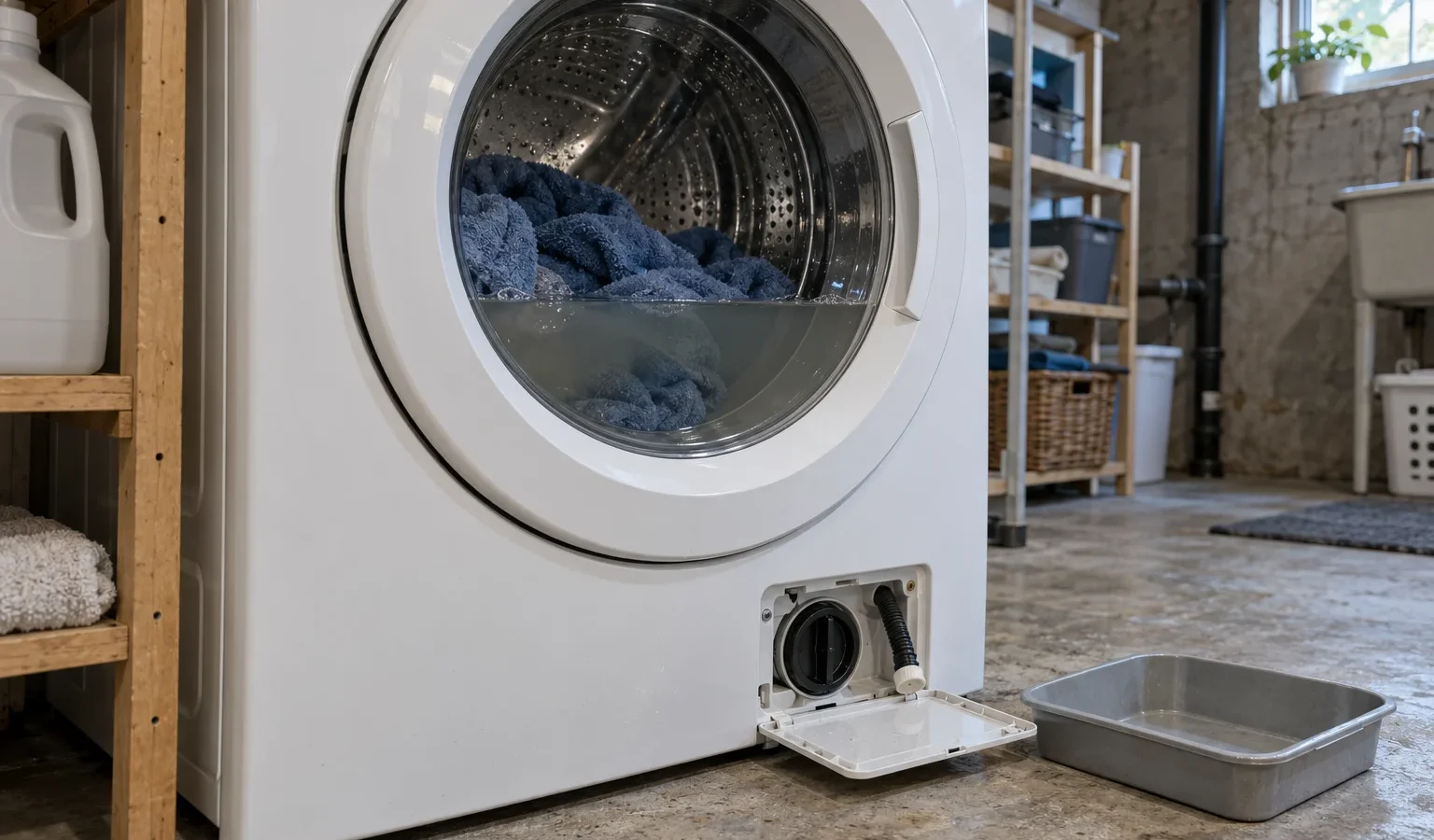
Many front-load washers have a small access door at the lower front that covers a drain screen or coin trap. If your Kenmore has one, it is the likeliest hiding place for a sock, coin or lint ball. Put towels and a shallow tray down first, because opening it with a full drum releases a lot of water. Turn the cap slowly and let the water out into the tray in stages. Clean what you find and refit the cap fully. If you cannot find an access door, do not hunt for one behind panels.
A top-load model such as the 26-29182 has no front trap; the pump sits underneath, and an obstruction usually means opening the cabinet, which is a technician task. The same applies to an impeller washer like the 26-29262. What an owner can do is check the hose, the standpipe and the unit’s level.
Sometimes the pump is fine and the washer simply is not asking it to run. A lid or door that is not seen as closed, a failed level sensor, or a control fault can leave water in the drum. If the washer shows a code, write it exactly and compare it with the code pages. If the lid or door was bumped open mid-cycle, close it and try Drain or Spin only.
Do not bail water out by lifting the washer or tilting it while it is plugged in. Do not run the washer again and again hoping it will clear, because every attempt adds water to a drum that cannot empty and can end up on your floor. Do not use drain chemicals through the washer. Do not open a panel to reach the pump while the washer has power. If water reaches the electrical area, switch off at the breaker.
A washer that overflows or leaks onto a hardwood floor in an upper unit becomes the neighbors’ problem quickly. If you rent, tell the landlord or building manager when water stays in the drum, particularly if the standpipe is shared. They are the people who clear house lines, while the washer’s pump and hose are the technician’s side.
Book when the hose and standpipe are clear but water remains, when the pump is silent, when there is noise suggesting a jammed pump, or when you have used the owner-accessible screen and still see the issue. The technician diagnoses the drain path before doing anything else, tells you what is wrong in writing with an estimate, and waits for your approval. Have the model number ready; it is usually inside the lid rim, door opening or on the back panel. Details are on our Kenmore washer repair page, and the Kenmore washer lineup page helps you find the label. If the drum also refuses to turn, see washer not spinning.
Yes. Small items slip past the drum holes and lodge in the pump inlet or drain screen. A front-load unit with an owner-accessible trap lets you remove them; on a top-load unit the pump sits behind panels.
Water rising in a shared sink usually means the standpipe or house line is partly blocked. That points to plumbing rather than the washer, so building maintenance may be the first call.
It is, with preparation. Place towels and a shallow tray, turn the cap slowly and let the water out in stages. If the cap is stuck, stop and book a visit rather than forcing it.
A slow drain is an early sign of a partial clog, a kinked hose or a tiring pump. It is easier and usually smaller to handle before it becomes a full stop.
A short power reset may clear a one-time control hiccup, but it does not remove a blockage or fix a pump. If the water stays, move on to the hose checks and then a diagnosis.
Share a few details and we’ll confirm an appointment. Prefer to talk? Call us and we’ll help right away.