

Specialized Kenmore Appliance Repair in San Francisco
Mon–Sat: 8:00 AM – 7:00 PM
If your Kenmore washer ignores the Start button, work through power, lid or door, water and control behavior before assuming a failed part.
Kenmore repair checklist · San Francisco Bay Area
The clothes are in, the detergent is measured, you press Start and the washer does nothing. It might be as dark as a switched-off appliance, or the panel lights up and then sits there, or you hear a click and then silence. A Kenmore washer that will not start rarely breaks all at once; it is waiting for a condition to be met, and one of those conditions is missing. Finding the missing condition is the job.
Look at the control panel before you do anything. A fully dark panel means power is not reaching the control. A lit panel with no response suggests the washer sees a reason not to start. A lit panel that begins a cycle, then pauses at fill, suggests water is not entering or the lid or door is not confirmed. A click followed by a hum can mean the motor is trying and failing. These signals sort the causes into groups.
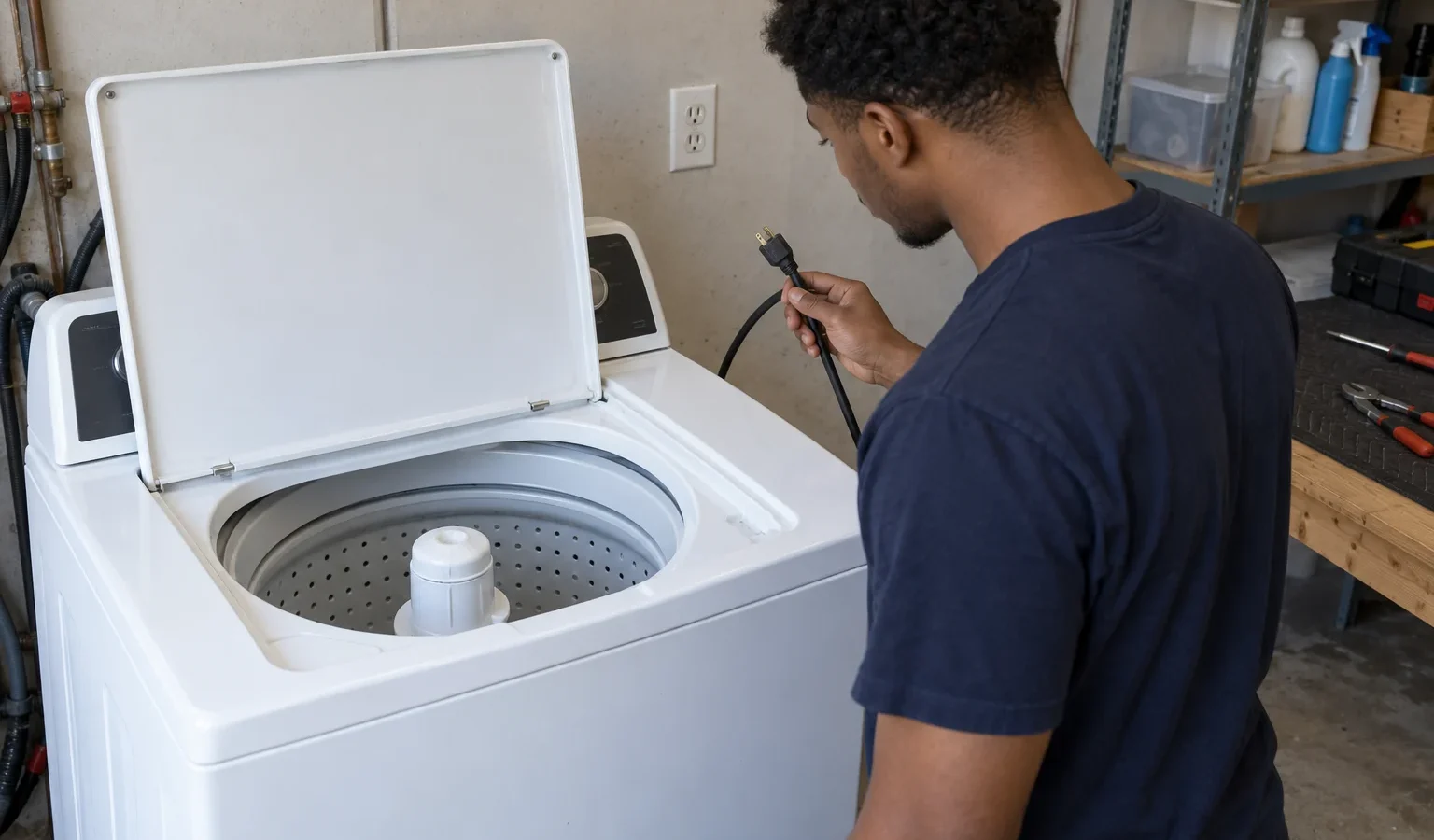
Start with the plug and the outlet. Washers are often tucked into closets or behind stacked dryers, and a plug can be pulled partly out when the machine is moved for cleaning. Check the breaker, and if the outlet is a GFCI, press its reset. In shared laundry rooms, a breaker may be shared with other machines or lighting. If the outlet has power and the washer remains dark, the power path inside the washer, a fuse or the control may have failed, and that is a visit.
The control will not run if it cannot confirm the lid is closed. Close it firmly and listen. On a top-load model like the 110.31632610, a lid that has warped or a switch that has worn can fail to register. On a front-load model like the 26-42272, the door lock must engage and the control then senses that it did. Pulling a stray sock out of the door seal sometimes does the whole repair. If the door will not lock, or locks and then unlocks, the lock assembly or its control may be involved.
Look for a control lock, a delayed start that was selected earlier, a cycle that is paused, or a Start button that needs a longer press. Many panels have a lock icon you can toggle. A delayed start looks like a washer that refuses to run when it is actually waiting for its set time. Confirm that the cycle selector and options match, and that you did not enable a feature your cycle cannot use.
If the washer begins and then stops at fill with no water, check both supply valves behind the washer, usually labeled for hot and cold. A valve that was closed during a move, or a hose that was kinked when the machine was pushed back, will starve the fill. Look for a code on the display, and if the washer shows one, write it down exactly. An inlet screen at the hose connection can clog with grit; a technician or careful owner can look at it after the water is off. If you rent and the valves are painted over or stiff, do not force them.
A single click with nothing else suggests the control is sending a signal that something is not answering. A hum may be the motor with a jammed load; stop and check for a stuck coin or a lump of heavy laundry wedged against the drum. A beep pattern means the control is giving a message, such as a lid not closed or an out-of-balance warning. Beeping paired with no cycle is worth recording.
Compact machines like the 26-41202 are often fitted into closets or under counters where the plug and valves are hard to see. A top-load washer relies heavily on the lid switch. A front-load washer relies on the door lock and gasket. Knowing which you own tells you where to look first.
Do not open the control console or the rear panel to look for a burnt part. Do not jump the lid switch with tape or a wire to force the washer to run. Do not use extension cords or adapters; a washer needs its own properly grounded outlet. If there is a burning smell or a scorched plug, switch off the breaker and call for service.
Shared laundry rooms in older buildings can have worn outlets and long-shared circuits. A washer that starts on one outlet and not another points to the supply, not the machine. Closet washers can lose their plug connection when the unit is slid back, so look there first after any move or cleaning.
If power, lid, settings and water are all in order and the washer still does not begin, book a visit. A technician will check the lid or door signal, the control and the water side in a sensible order, give you a written estimate and wait for your approval before repairing. Have the model number ready. More detail is on our Kenmore washer repair page, and the Kenmore washer guide shows where labels sit. If water stays in the drum after a stop, read washer not draining.
A lit panel with no cycle usually means the control is waiting on a lid or door signal, a lock setting or a delayed start. Close the lid or door firmly and check the panel for a lock or pause indicator.
Yes. Laundry outlets are often GFCI protected, and a tripped one removes all power. Press reset on the outlet, then try again, and if it trips repeatedly stop and book a visit.
The control is sending a signal but nothing is answering. Common reasons include the lid or door lock, water supply and a motor that is jammed. A technician can find which.
One controlled power reset is a fair check, either by unplugging or using the breaker. Wait briefly, restore power, and try Start once. Repeated resets do not fix a failed part.
Moving can loosen a plug, kink a supply hose, close a valve or shift the lid or door alignment. Recheck all four before assuming a part has failed.
Share a few details and we’ll confirm an appointment. Prefer to talk? Call us and we’ll help right away.