

Specialized Kenmore Appliance Repair in San Francisco
Mon–Sat: 8:00 AM – 7:00 PM
A washer that walks across the floor or bangs the wall during spin is out of balance, out of level, or wearing a suspension or bearing part. Learn how to tell them apart.
Kenmore repair checklist · San Francisco Bay Area
There is a point in the spin cycle when the washer sounds like it is trying to leave the room. The cabinet jumps, the lid rattles, and something thumps the wall or the cabinet next to it. In a San Francisco flat with a shared floor, the sound may carry to the neighbors below. A Kenmore washer that shakes hard is usually responding to one of four things: an uneven load, a washer that is not level, a floor that flexes, or worn parts that no longer absorb the motion. Only the last one needs a technician.
That question splits the problem in half. If a washer has always shaken and the installation was recent, look at the leveling and the floor first. If it ran quietly for years and has started shaking, suspect wear in the suspension, the shock-absorbing parts, the bearings or the drum support. A change in behavior is the strongest clue you can give a technician.
One heavy item, such as a wet jacket or a rug, spinning alone can throw the whole drum off. Light items like a few pillowcases can also clump into one side. Stop the washer, open it, and spread the clothes around the drum. Mix large and small items. On a top-load washer, make sure nothing is wrapped around the agitator or the center post. On a front-load washer, check that a heavy item has not become trapped between the drum and the gasket.
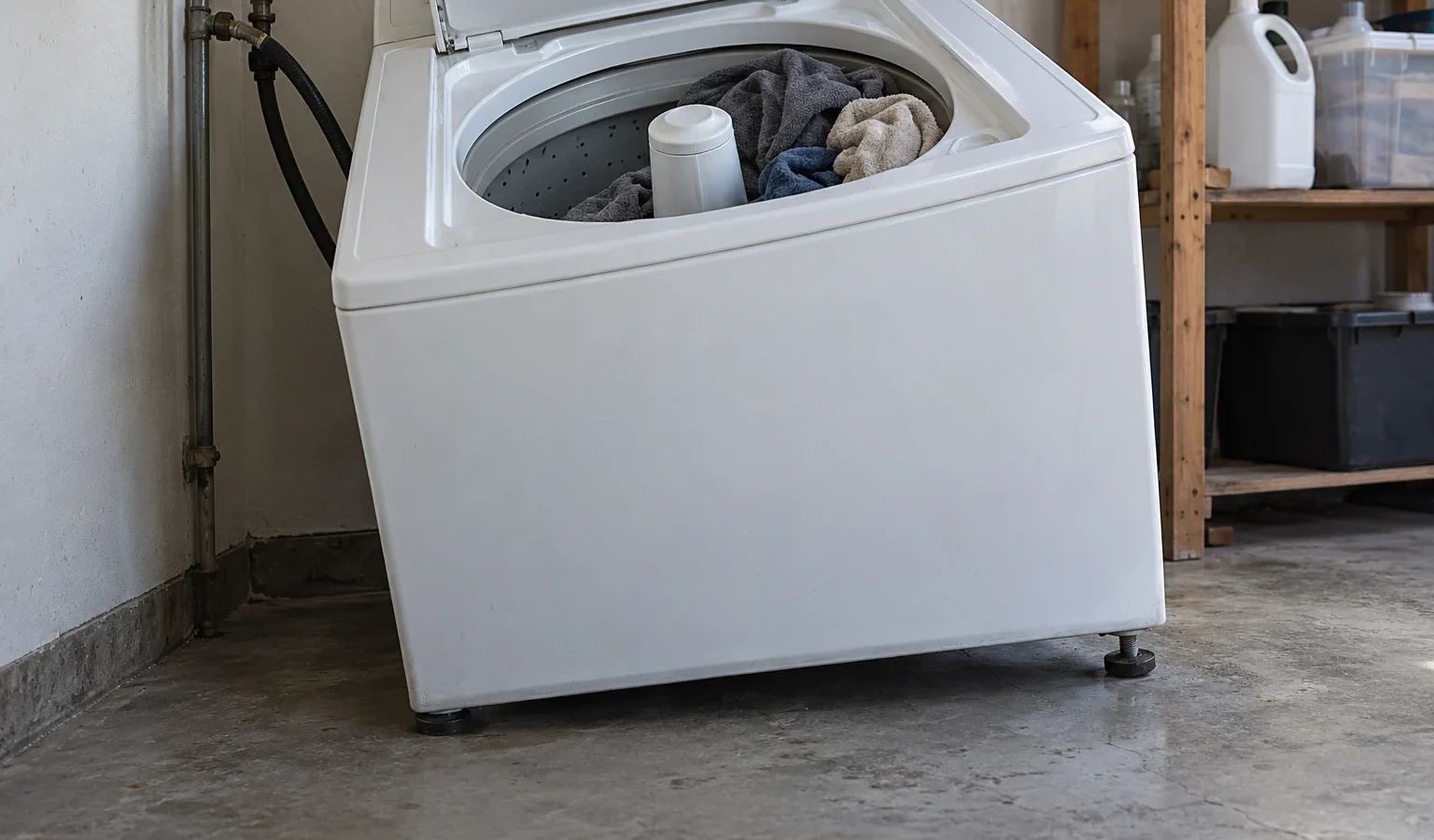
A washer that rocks even slightly will vibrate worse as the spin speeds up. Push down on each top corner and see whether the cabinet rocks diagonally. Front-load washers have adjustable feet at the corners, and top-loads typically have them at the front and fixed or adjustable rear legs. The feet have locking nuts that must be tightened against the base after leveling, or they work loose from vibration. Use a level on top of the washer in both directions. Keep your fingers clear when the washer is moved, and never tilt a washer with water inside.
A perfectly level washer can still shake if the floor moves. Older upper-floor flats in the city often have wood floors with some spring in them, and laundry closets built over the span between joists can bounce. If the washer sits on a platform or pedestal in a closet, the platform itself may not be rigid. If the shaking stops when you run a small load and returns with a big one, the floor is a likely contributor. A tenant cannot fix a floor, but you can tell the landlord and show where the movement is.
Front-load washers and some top-loads are shipped with transit bolts or blocks that hold the drum still. If these were never removed, the washer will shake and bang, particularly on a recent move or a new install. The label on the back or in the installation sheet shows whether your model uses them. Check the rear panel for leftover bolts or foam pieces. Also look at whether the supply hoses, drain hose or power cord are pressing against a wall and transmitting noise.
A washer that is level, balanced and on a solid floor but still thumps is telling you about wear. On a top-load washer such as the 26-29162, the suspension rods or the parts that keep the tub from swinging can wear. On a front-load washer like the 26-42272 or the compact 26-41202, shock absorbers, springs, drum bearings or tub supports can be the cause. Rumbling or a grinding growl that continues after the wash is rinsed out is a typical sign of a bearing. Those are descriptions of the type, not reports about a specific unit.
Do not keep running a washer that bangs hard; it can damage the cabinet, hoses and the floor, and a dislodged hose can flood a unit. Do not stand something heavy on top of the washer to hold it down. Do not open the cabinet and tinker with springs or rods. If the washer begins to smell hot or burnt, switch off at the breaker and stop using it.
Where the dryer sits above the washer on a stacking kit, shaking becomes a bigger problem, because the movement affects both machines. A tilt in the bottom washer is multiplied at the top. In a closet, a washer that touches the door frame or the dryer will thump against it. These installations reward careful leveling and a small gap around the cabinet. A technician can tell you whether the stack is a factor.
Book when leveling, load and floor checks do not calm the washer, when the sound is a grinding roar, when the drum wobbles or when you notice a leak with the shaking. The technician diagnoses first, provides a written estimate and repairs only what you approve. Bring the model number from the lid rim or door opening. See our Kenmore washer repair page, or read the Kenmore washer guide for label locations. If the drum also fails to turn, read washer not spinning.
Heavy loads magnify small leveling or floor problems, and a big load can also bunch to one side. If small loads run quietly, the floor and feet are the usual place to look.
Rebalancing the load, leveling the feet and removing transit bolts are owner-level steps. Anything that involves opening the cabinet, such as suspension parts or bearings, belongs to a technician.
It can be, particularly if the noise continues as the drum slows. It is also worth checking for a coin or small object. If the sound persists with an empty drum, book a diagnosis.
Yes, if it continues. Hard banging strains hoses, the cabinet and the drum support, and in a flat it can be hard on the floor below. Stop the cycle and fix the cause.
A newly installed washer that shakes often still has transit bolts or blocks in place, or it has not been leveled. The installation sheet shows which applies to your unit.
Share a few details and we’ll confirm an appointment. Prefer to talk? Call us and we’ll help right away.