

Specialized Kenmore Appliance Repair in San Francisco
Mon–Sat: 8:00 AM – 7:00 PM
When a Kenmore washer fills and agitates but leaves clothes soaked, the spin stage is being blocked. These are the common reasons and the checks you can make safely.
Kenmore repair checklist · San Francisco Bay Area
Few laundry problems feel as obvious as a washer that finishes its cycle and hands you a drum of dripping clothes. The water filled, the wash action ran, perhaps the drain even sounded normal, but the spin never reached speed. On a Kenmore washer this can mean a load that tipped out of balance, a lid or door that is not telling the control it is closed, water that never fully left, or a drive part that has worn out. The symptoms differ a little between top-load and front-load machines, and the difference helps.
Owners use the phrase for three different things. Some mean the drum does not turn at all during spin. Others mean it turns slowly or lurches and then stops. A third group hears the motor spin up but sees nothing move. Notice which one you have, because a silent drum, a struggling drum and a freewheeling drum have different usual suspects.
A washer protects itself from violent shaking by refusing to reach full spin when the load is lopsided. A single wet bath rug, a comforter bunched on one side or a few heavy towels with nothing to balance them can make the control abort the spin and sometimes the cycle. Open the lid or door, redistribute the clothes, take out the heaviest item, and run only the spin step. This one check solves more calls than any other, particularly in homes with a stacked or closet laundry where the washer sits snug and cannot rock freely.
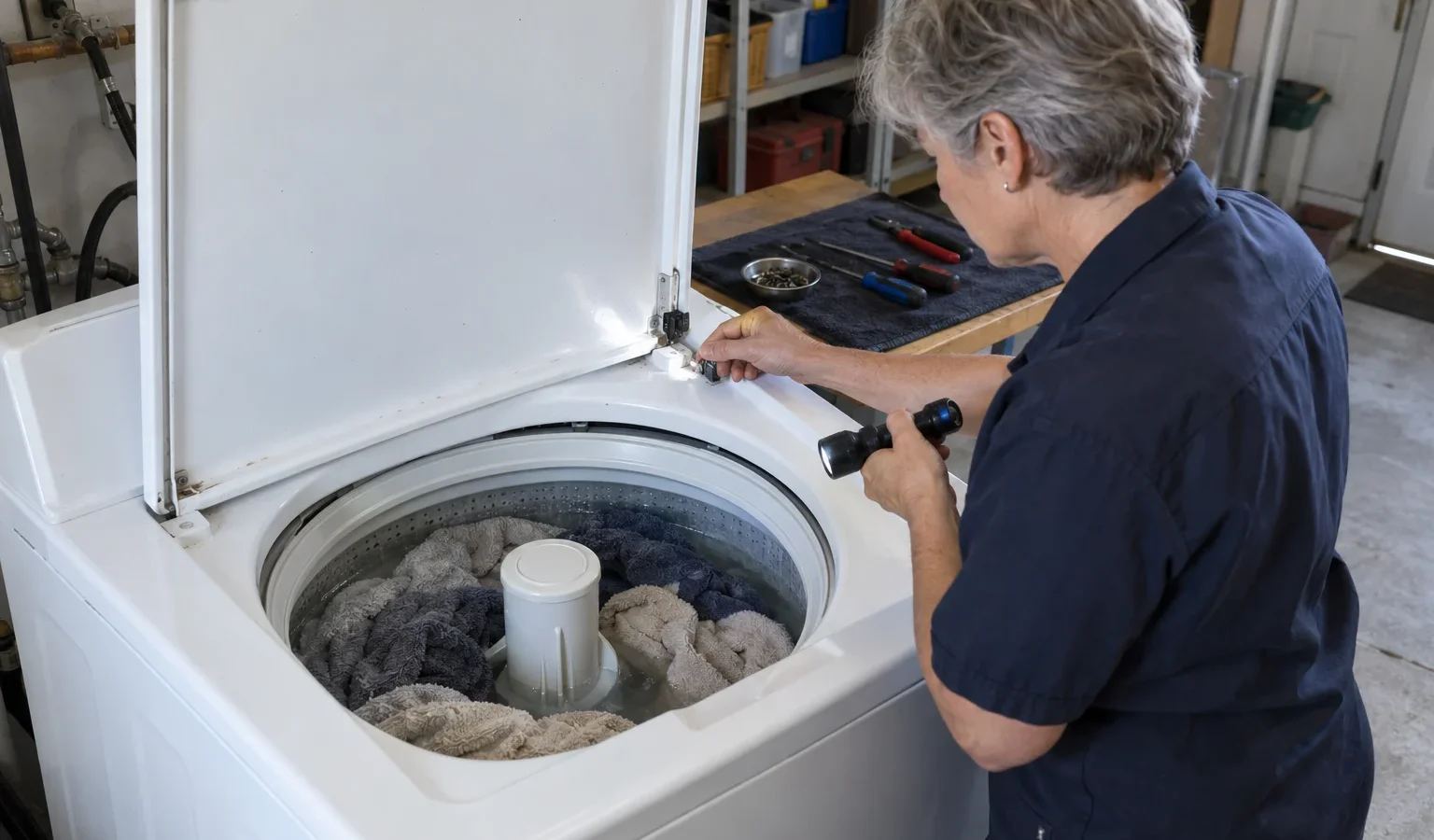
The spin will not begin unless the control sees the lid or door closed. On a top-load washer, the lid switch is a small part under the lid hinge area; when it wears, the washer fills and washes but will not spin, or it spins only when you hold the lid a certain way. If the washer works when you press down on the lid and stops when you let go, that is a strong sign. On a front-load washer the door lock does the same job and also keeps the door from opening while the drum is wet. If the door latches loudly but the washer never starts to spin, the lock or its control signal may be at fault. Neither is an owner repair, but you can note the behavior for the technician.
Many washers will not spin until the water is gone. If you open the lid and find the tub still full, the problem is draining rather than spinning, and the washer not draining article is the better path. Look for a kinked drain hose behind the washer, a clogged drain screen or coin trap on a front-load unit, and a standpipe that is too snug around the hose. In shared laundry rooms, tenants sometimes push a washer so close to the wall that the hose collapses.
On a top-load agitator washer such as the 26-29162, a transmission or coupling problem can make the agitator move while the basket will not turn. On an impeller type such as the 26-29262, a worn coupling or drive part has a similar effect. On a front-load model like the 26-42272, a failing drive motor, a motor control, a belt or a bearing problem can stop the drum. Those are model-type examples of where technicians look, not claims about any one machine.
Do not pull the back or top panel to look at the belt or motor while the washer is connected. Do not force the drum by hand while the machine is plugged in, and do not wedge the lid switch closed to defeat it. Water, spinning parts and mains power are a poor mix for guesswork. If you smell burning or see sparks, power off at the breaker.
Closet and stacked laundry setups limit how far the washer can be moved, and a drum that vibrates against the closet wall can trip the unbalance protection even with a well-balanced load. Upper-floor flats with older flooring may also let the washer shift during spin. If the problem only shows with bigger loads, mention it, because it separates a floor and leveling problem from a failed part.
If the rebalanced load, a clear drain and a power reset change nothing, the next step is a diagnosis. The technician checks the lid or door signal, the drain path, the drive and the control in a logical order, gives you a written estimate, and repairs only what you approve. Have the model number ready, usually on the inside rim of the lid or door opening or on the rear panel. Our Kenmore washer repair page explains the visit, and the Kenmore washers guide covers where labels are found.
The drain can finish while the spin step is held back by an unbalanced load, a lid switch or door lock problem, or a worn drive part. Rebalancing the load and checking that the lid or door closes cleanly are the quickest tests.
A short pause while the washer redistributes the load or confirms the lock is typical. A long pause that ends with the cycle stopping is a sign of imbalance or a lock problem.
On models that use one, yes, a loose or broken belt lets the motor run without turning the drum. A technician confirms this because the belt is behind panels you should not open.
The smell usually comes from the door gasket and drain trap, while the spin issue is mechanical or electrical. They can occur together, so mention both at the visit.
Often yes, since many spin faults are a single worn part. Ask for the written estimate after the diagnosis, then weigh it against the washer’s condition and your laundry setup.
Share a few details and we’ll confirm an appointment. Prefer to talk? Call us and we’ll help right away.