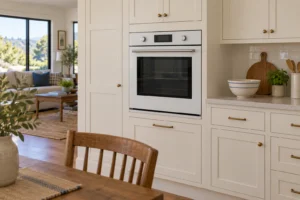
Wall Ovens
Single, double and combination Kenmore wall ovens in San Francisco: heating faults, locked doors, F codes and the checks you can safely…

Specialized Kenmore Appliance Repair in San Francisco
Mon–Sat: 8:00 AM – 7:00 PM
Built into the cabinet at eye level, a Kenmore wall oven needs the right diagnosis before it is pulled, so we find the fault first and quote it in writing.
Kenmore repair checklist · San Francisco Bay Area
Wall ovens sit inside a cabinet housing, often in a tall run beside the refrigerator or above a drawer, and that placement shapes every repair. The unit is heavy, wired directly or through a junction box, and secured through its side flanges. Our technicians therefore work out what has failed from the outside first and only then decide whether the oven has to come out of the cutout. We service Kenmore wall ovens, single and double, in San Francisco homes and across the Bay Area.
A bake or broil element that has opened, a relay that no longer closes, a cooling or convection fan fault, or a control that has shut the oven down can all leave you with a cold cavity. The article Kenmore oven not heating goes through the likely paths.
Overbaked or underbaked food usually traces back to the temperature sensor, the control board, or a door gasket that no longer seals well. See Kenmore oven temperature off for what we examine.
After a self-clean cycle, a lock motor or switch can leave the latch engaged. Do not force it. The guide Kenmore wall oven door locked explains what is behind it.
A key that is stuck, a ribbon connection that has worked loose or a control that has failed can freeze the panel. Some of these also appear as F-codes.
A lamp or a cooling fan problem may seem minor, but a stalled cooling fan can lead a control to stop the oven, so it deserves a look.
Many Kenmore wall ovens show an F followed by a number, and some show it as an F-code and E-code pair. The meaning depends on the series, and we note which family each code belongs to. Examples:
| Code | What it reports |
|---|---|
| F1 | A defective electronic oven control |
| F2/E0 | The keypad wire harness is disconnected |
| F3/E0 | A defective oven temperature sensor, or an open sensor circuit |
| F4/E1 | The meat probe is shorted |
| F5/E0 | The door is open but the latch is locked, as the door and latch switches disagree |
| F5/E1 | The self-clean latch will not lock or unlock |
| F9 | An oven door lock failure |
Two more are worth knowing. F0 is a default code and signals no failure, and F3 without an E-code is an oven temperature sensor failure on certain self-cleaning and manual-cleaning units. Our Kenmore oven error codes article puts them in context. A code tells us where to look, and a technician still has to confirm that the sensor, wiring or board is the real cause before replacing anything.
In many San Francisco kitchens the cabinet run was built for an earlier oven, and replacement units do not always line up with the opening. If an old unit is being replaced, mention it, since that is a separate job from a repair.
Do not try to pry a locked door open, do not disconnect wiring, and do not bypass any lock or sensor.
Shut the oven off at the breaker if there is smoke you cannot explain, a burning smell, sparks, or a door that cannot be closed. Do not run a self-clean cycle on an oven that has already thrown a lock or sensor code. If a cleaning cycle is in progress and the oven is giving off heavy smoke, open a window and cancel the cycle.
Wall oven parts such as lock motors, sensors, relays and control boards vary by model. The label is usually found on the oven frame, close to the door opening and sometimes along the side of the cavity. A photograph of the label, together with the code on the display, is the fastest way to get an accurate first answer. Many Kenmore wall ovens in the Bay Area are older built-ins, and the label tells us whether we are dealing with a manual-clean or self-clean model.
Our technician confirms power, examines the display and door behavior, and tests the heat, sensor and lock circuits that match the symptom. You get a written diagnosis and an estimate. We repair only with your approval, and we run the oven through a test before we pack up.
Our overview of Kenmore wall ovens describes what we service. If your oven is part of a freestanding unit, visit Kenmore range repair, and for the burners above the counter, see Kenmore cooktop repair.
F0 is listed as a default code with no failure. If the oven works normally, keep an eye on it. If it won’t heat or lock, tell us what else you see.
The latch may not have received the signal to release, or its switch or motor may be failing. Pulling on the door can damage the latch, so wait for us.
Yes. Each cavity has its own heating parts, so a fault may affect one oven and not the other. We test both during the visit.
It helps to clear the area in front and any adjacent cabinet that a technician might need to reach.
The model number, the full code, whether it is a single or double oven, and what happened just before the problem began.
Single, double and combination Kenmore wall ovens in San Francisco: heating faults, locked doors, F codes and the checks you can safely…
Kenmore cooktop repair in San Francisco and the Bay Area: gas burners that will not light, electric and induction elements that stay…
Standing water, dirty dishes, leaks and no-start problems on Kenmore dishwashers, checked from the drain path and the door latch through to…
Kenmore dryer repair in San Francisco and the Bay Area for electric and gas units: no heat, long dry times, no tumble,…
Chest and upright Kenmore freezers that stop freezing, ice over or run nonstop, diagnosed in garages, closets and kitchens around the Bay…
Share a few details and we’ll confirm an appointment. Prefer to talk? Call us and we’ll help right away.