

Specialized Kenmore Appliance Repair in San Francisco
Mon–Sat: 8:00 AM – 7:00 PM
A Kenmore wall oven that stays locked after cleaning, or locks without warning, has a latch, switch or control issue. See what is normal, what is a fault, and what to try.
Kenmore repair checklist · San Francisco Bay Area
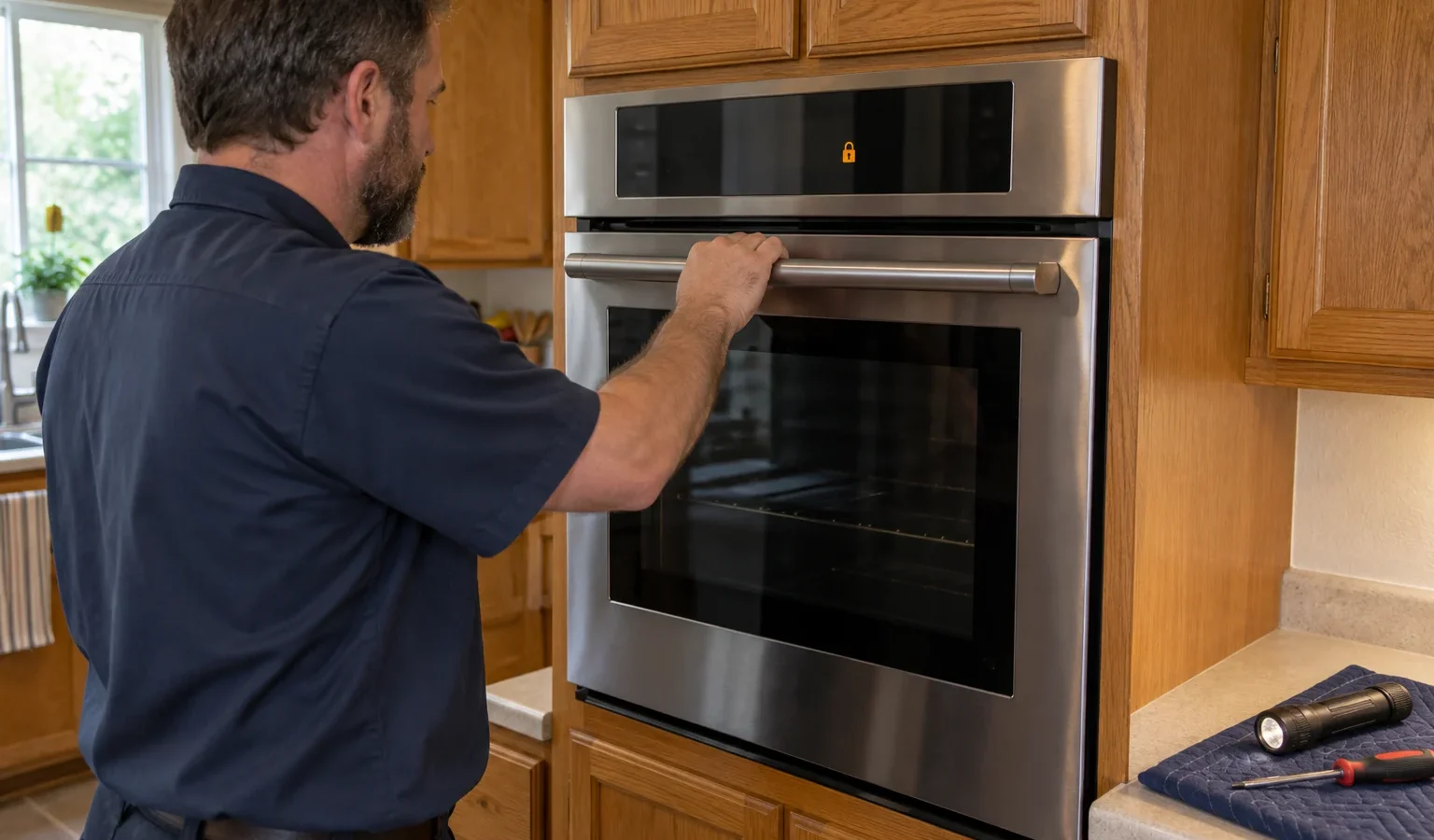
A locked wall oven door can be perfectly normal or a real fault, and the difference is simple: is the oven still hot or in a clean cycle, or is it cold and idle? Start there before you pry at anything.
During a self-clean cycle the oven latches the door and keeps it locked until the cavity cools. The lock light may stay lit for a long stretch after the cycle ends, because the control waits for the interior to cool before releasing. If the cycle finished a short while ago, wait. Give it time, and look for a clear display before concluding anything.
If the oven is cold, idle, off, and the door is still locked, the latch motor or its switches are not releasing. The control uses a pair of switches, one for the door and one for the latch, to know the state. If they disagree it stops and may post a code. On several wall ovens the code is F5/E0, meaning the door is open but the latch is locked, and F5/E1, where the self-clean latch will not lock or unlock; see Kenmore wall oven F5/E0 error code and Kenmore wall oven F5/E1 error code. A listed oven door lock failure also appears as F9, at Kenmore wall oven F9 error code. Which codes apply depends on your model.
Do not force the door with a tool, because a latch hook under tension can break and the glass can crack. Do not take off the trim or the control panel, and do not bypass the door switch. Wall ovens sit inside tight cabinetry, and prying can damage both the unit and the cabinet. If you smell burning or see sparks, shut off the breaker. If your wall oven is gas and you smell gas, leave and call the gas utility or 911 from outside.
A wall oven is set into a cabinet cutout and wired to its own circuit. A door that rubs the cabinet frame, or a unit that is slightly out of level, can misalign the latch. Mention any recent cabinet work or moving of the oven, and say whether it is a single unit or a double stacked oven, since the upper and lower doors lock separately.
We confirm power, read the code, test the switches and the latch motor, and check door alignment. You get a written estimate, and no repair begins until you approve it. If the door is stuck shut, the technician can often release it safely as part of the diagnosis without damaging the glass. Start with Kenmore wall oven repair and see Kenmore wall ovens for the lineup. If the oven is also not heating, see Kenmore oven not heating.
The lock indicator is not always a fault signal. On many wall ovens it lights when the latch motor drives the hook closed and stays on until the cavity is cool enough to release. A flashing light, however, or a light that stays on with an idle, cold oven, suggests the control is waiting for a signal that never arrives. Note whether the light is steady or flashing and what the display says next to it.
It also helps to remember what happened right before the problem. A cycle interrupted by an outage, a door that was opened while the latch was moving, or a recent clean cycle that ran long are all useful facts. When you call, share them in order, along with whether the oven is a single or double unit.
A single wall oven has one latch and one set of switches. A double has two, and a combination oven with a microwave above adds another door that behaves independently. If only the lower door of a double sticks, the fault is in that oven’s latch assembly, not in the whole stack. When both stay locked, power or the main control is a likelier cause. Mention which door and whether the other oven heats and cooks normally, because the technician can then bring the right latch assembly.
Latch motors and switches differ by oven, and a single unit uses a different assembly from a double. The label is usually on the oven drawer frame or the edge of the cavity front. Having the whole number ready lets the right part come on the first visit.
The latch stays closed until the cavity cools, and the lock light can stay on for a long time. If it stays locked once the oven is cold, the latch or its switches need testing.
No. Forcing it can break the hook or crack the glass. Let a technician release it safely.
One controlled reset at the breaker sometimes helps the latch re-learn its position, particularly after an outage. Repeating it does not help.
On the ovens that use it, the door is open but the latch is locked, because the door switch and latch switch disagree. Check the model for the exact meaning.
Each oven has its own latch, so the upper and lower doors can behave differently. Tell us which one is stuck.
Share a few details and we’ll confirm an appointment. Prefer to talk? Call us and we’ll help right away.