

Specialized Kenmore Appliance Repair in San Francisco
Mon–Sat: 8:00 AM – 7:00 PM
When cookies burn or roasts stay pale, the oven may be misreading its own temperature. See the causes behind a Kenmore oven that runs off its setting.
Kenmore repair checklist · San Francisco Bay Area
An oven that bakes unevenly is easy to blame on the recipe. Before you do, consider that the oven may simply not be holding the temperature you set. The fix depends on whether it runs warmer or cooler than the dial claims, and whether the error is steady or varies from batch to batch.
The oven probe is a slim rod at the back of the cavity. It changes resistance with heat, and the control reads that value to decide when to switch the heating on and off. If the probe is partly failing, its readings wander. Sometimes the control catches the fault and shows a code; our pages for the Kenmore range 3d/11 error code and the Kenmore range F30 error code describe sensor faults on the ranges they cover. A wandering probe that stays inside the control’s tolerance gives no code at all, just inconsistent baking.
Another version of the same issue is an oven that reports too hot. Pages like Kenmore range 1d/11 error code cover that on units that use it, but nearly all ovens that run too warm do so without any message.
A worn or torn door gasket lets hot air leak out, so the oven works harder and the temperature at the rack drops. Look around the whole door frame for gaps, darkened or flattened sections, or a gasket that no longer springs back. Check that the door closes squarely; a door sagging on a hinge can leave a visible gap at the bottom. Foil laid across the oven floor can also alter airflow and hide the true temperature near the element, so remove it before judging results.
If the oven offers a convection mode and results change when you switch it on, the fan is part of the story. A fan that is slow or noisy mixes air poorly. Many ovens also depend on a small fan cooling the electronics; when that runs poorly, the control can behave oddly. Listen for a rattle or grinding and tell us what you hear.
A steady gap is useful information for the technician. A gap that changes every time points to a sensor, a connection or a relay. A repeated odd result is worth reporting, but you should not open anything yourself.
Some Kenmore controls let you offset the displayed temperature. That is fine for a small constant drift, for example when an older oven has simply drifted over the years. It is the wrong tool when the cause is a failing probe or an element that is cycling badly, because the problem comes back and sometimes grows. If you have already adjusted the offset, tell us.
Do not run self-clean to see if the oven resets. Do not pull the probe out or bend it; it is fragile and positioned precisely. Do not remove the back panel in a gas oven, because the burner and gas parts sit nearby. If you smell gas, leave and call the gas utility or 911 from outside. If you notice burning smells or sparks, switch off the breaker.
If the thermometer keeps disagreeing with the setting after you have checked the door seal and cleared the racks, it is time for a diagnosis. We test the probe, the heating components and the control, give you a written estimate, and repair only what you approve. Visit Kenmore range repair, read about Kenmore ranges, or if the oven is not heating at all see Kenmore oven not heating.
Before blaming the oven entirely, rule out the ordinary causes. Dark pans absorb more heat than shiny ones, glass dishes retain it longer, and a rack set too high or too low changes results as much as a few degrees would. Crowded racks block airflow, and a tray that covers most of a rack leaves the corners starved. Preheat fully, wait for the oven to settle, and try the same dish on the middle rack with nothing else inside.
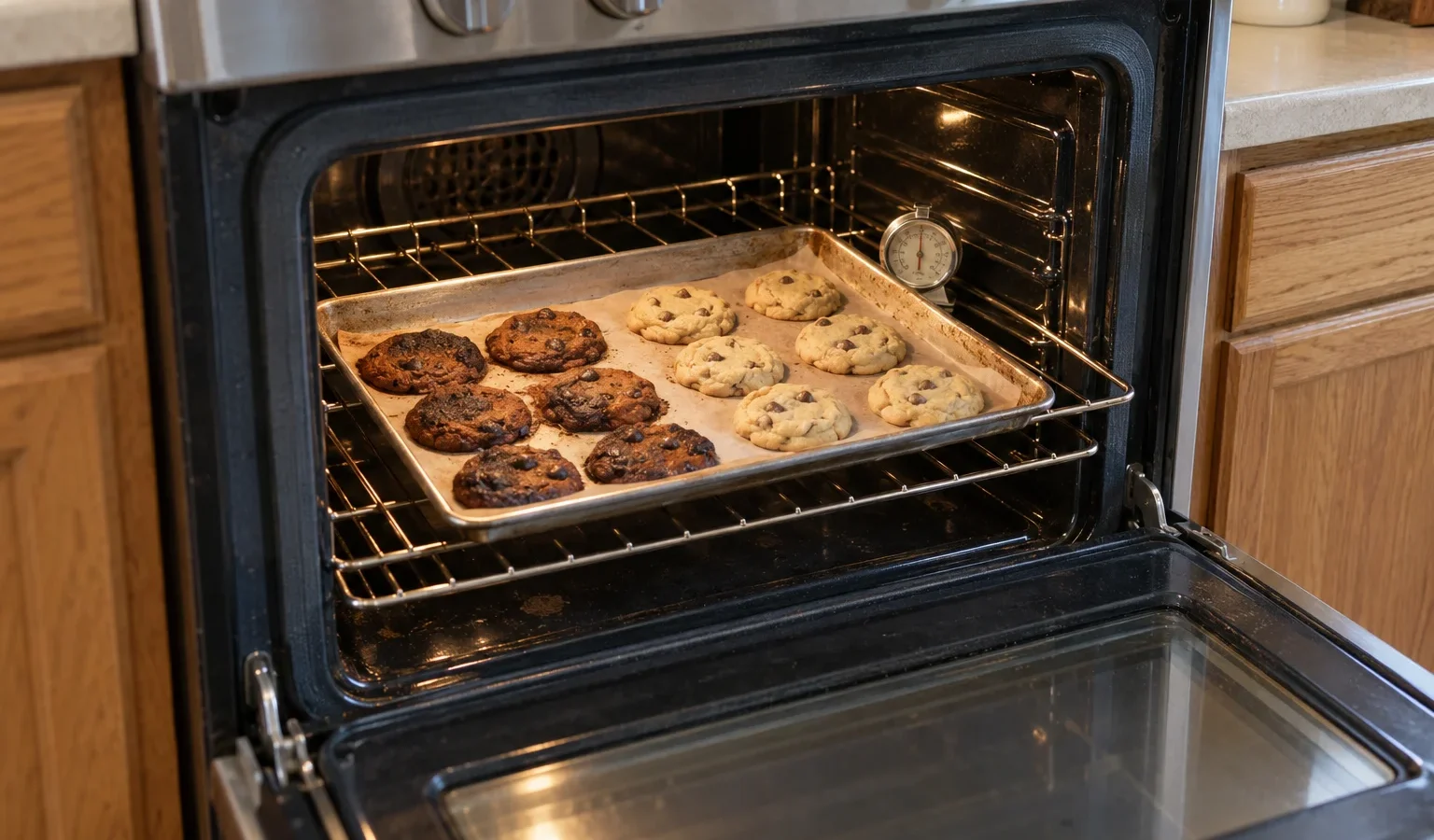
If the same recipe still behaves differently from last year, and especially if a sheet of cookies bakes uneven from front to back, bring that observation with you. It tells the technician whether the problem sits in the heat source, the airflow or the sensor.
Probes and elements are model-specific. The full number is usually on the oven frame. For example, the Kenmore 22-96853 repair entry is an induction range, and the Kenmore 790.90152 repair entry is a discontinued smoothtop range, no longer sold new; each calls for different parts.
A probe that reads low, a sticking relay or a worn control can all let the oven keep heating. A thermometer test over a couple of days shows whether the gap is steady.
Uneven browning is usually airflow, a weak element or flame, or a door that does not seal. Remove foil from the floor and check the gasket first.
Some controls offer a temperature offset in the settings. It helps a small steady drift, but it does not fix a failing sensor or element.
Yes. A torn or flattened gasket lets heat escape, so the oven has to work harder and the rack temperature drops.
Not always. Many drifting probes stay inside the control’s tolerance and give no message, which is why testing is needed.
Share a few details and we’ll confirm an appointment. Prefer to talk? Call us and we’ll help right away.