

Specialized Kenmore Appliance Repair in San Francisco
Mon–Sat: 8:00 AM – 7:00 PM
If the light, plate and fan work but food stays cold, the high-voltage side of a Kenmore microwave has probably stopped. Learn the signs and what is safe to check.
Kenmore repair checklist · San Francisco Bay Area
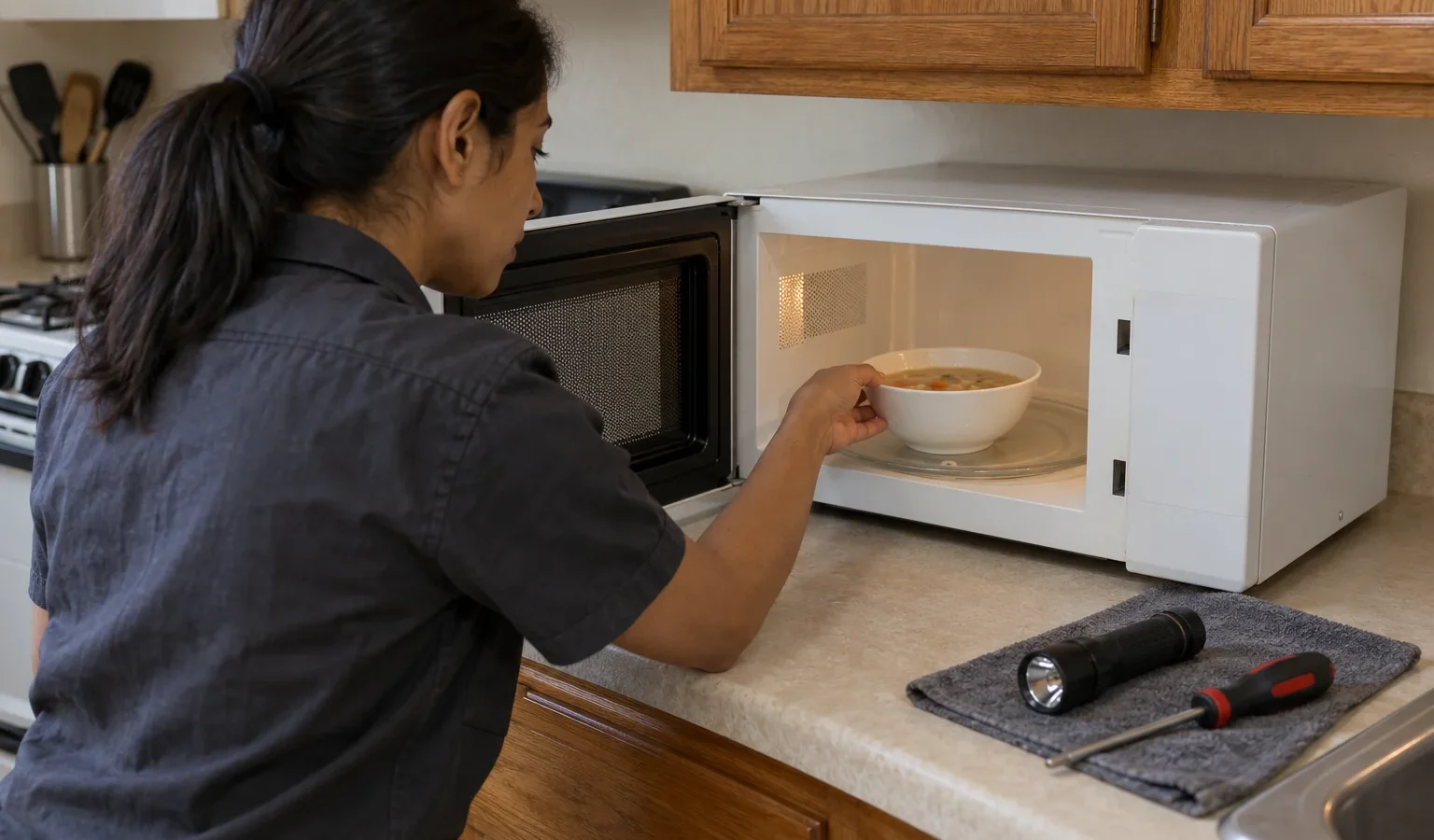
A microwave that hums, lights up and turns the plate while the food stays cold has lost its heating circuit while the rest of the unit carries on. That split is useful: the controls, door and motor are alive, so the problem sits in a smaller group of parts that make the microwaves themselves.
Inside the cabinet a component called the magnetron generates the energy that warms food, powered by a transformer, a capacitor and a diode that boost household power to a much higher level. A fuse and several safety switches sit in line with all of this. When any of those fail, the cavity light and fan can keep working because they use a different path. The result is a microwave that looks healthy and does nothing.
Listen. A normal microwave has a clear low hum when it cooks. If the hum is missing but the fan and plate work, the heating circuit is not starting. A loud buzzing, humming that changes pitch, or a burning smell calls for powering the unit off at once. If there are sparks inside, stop and unplug it or turn off its breaker. A dark, scorched spot on the cavity wall near the waveguide cover is another sign to keep it off.
Do not open the cabinet, even when the microwave is unplugged. The capacitor can hold a dangerous charge long after the unit is off, and you cannot see or sense that. Do not bypass door switches, do not run the microwave empty to test it, and do not keep using it if the door is warped, the latch is broken or sparks appear. For an over-the-range unit, do not lift it off the bracket yourself; it is heavy and wired into the cabinet and exhaust.
A countertop microwave can be unplugged and carried to a bench, but the voltage hazard is the same, so it still needs a trained hand. An over-the-range unit also acts as a hood, and many San Francisco kitchens have them above a narrow range with ducting or recirculating vents. If the fan runs but the heating does not, the two functions are separate and the fault is in the cooking side. We note how the vent is routed so the unit can be removed and refitted properly.
With newer units the question is whether the repair is sensible for what the appliance does. Often a bad fuse, switch or capacitor can be fixed without much trouble, while a failed magnetron or control may lead you to consider a replacement. Our guide on repair or replace a Kenmore appliance lists the factors without the guesswork.
The technician checks power, tests the door switches, then tests the fuse, capacitor, diode and transformer before pointing at the magnetron. You get a written estimate, and nothing is repaired without your approval. Start with Kenmore microwave repair and the Kenmore microwaves overview.
Not every cold microwave is a big repair. If it stopped after a power flicker, the internal fuse may have opened, which is one of the simpler repairs. If the door has been slammed or the handle feels loose, a switch may no longer be reading closed. If it heats weakly rather than not at all, a failing capacitor or a tired magnetron can be responsible, and food that is warm only at the edges is a clue.
Stains or damage inside the cavity matter, too. A burned spot, peeling paint or a cracked waveguide cover can cause arcing and should be looked at before using the oven again. If you see any of those, keep the unit off and describe what you see when you book.
Built-in microwaves sit in a trim kit inside the cabinetry, and over-the-range models hang from a wall plate and a top bracket. In either case the unit must be removed to be bench tested, which means disconnecting power, supporting the weight and freeing it from the cabinet. In a tight San Francisco kitchen, that can mean clearing the countertop below and protecting the range surface. Let us know the install type, how high the unit sits and whether a stepladder will be needed.
Magnetrons and fuses differ across models. Look for the label inside the door frame or on the cabinet side. Pages such as Kenmore 22-83383 repair and Kenmore KMCMB809BK09 repair show how we group microwaves by model.
The fan, light and plate use separate circuits from the heating circuit. A fuse, switch, capacitor, diode, transformer or magnetron failure can stop heat while everything else works.
No. A capacitor inside can keep a dangerous charge after the unit is off, so the cabinet should stay closed.
No. Running a microwave without anything inside can damage it. Use a cup of water if you want to test heating.
The transformer or capacitor may be running while the magnetron is not producing. Stop using it and have it diagnosed.
Yes. The microwave will not start heating unless its door switches confirm that the latch is closed.
Share a few details and we’ll confirm an appointment. Prefer to talk? Call us and we’ll help right away.