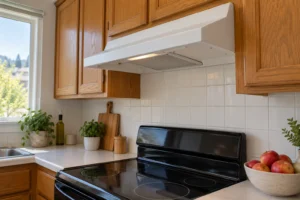
Range Hoods
Ducted and recirculating Kenmore range hoods in San Francisco kitchens: weak airflow, noisy blowers, dead lights, label tips and checks to try…

Specialized Kenmore Appliance Repair in San Francisco
Mon–Sat: 8:00 AM – 7:00 PM
Fans, lights and airflow problems on ducted and recirculating hoods, found before anything is replaced.
Kenmore repair checklist · San Francisco Bay Area
The range hood is the part of a San Francisco kitchen that nobody thinks about until the smoke alarm goes off. Cooking in a narrow galley or a flat with few windows means steam, grease and smoke have to go somewhere, and the hood is the only thing between the stove and the ceiling. When a Kenmore range hood fan stops, runs weakly, or rattles, the kitchen shows it quickly. Our Kenmore range hood repair service diagnoses the fault first and explains it in a written estimate before any work is approved.
A hood fan that stays silent on every speed can point to the wall switch, the control panel, a loose connection, the motor itself, or a protection device that has opened because of heat. Plugged-in hoods can also lose power at the outlet. A technician follows the power from the supply to the motor rather than swapping parts at random. For a full walk-through of that symptom, read Kenmore range hood fan not working.
If the fan spins but smoke lingers, the problem is often in the air path. Grease can clog the filters, a stuck damper flap at the duct can block exhaust, and a kinked or crushed duct run chokes the whole system. A hood on a long duct to the outside faces more resistance than one on a short run.
Rattling, scraping or a rhythmic thump usually comes from the blower wheel, which can pick up a layer of grease and fall out of balance, or from a loose mounting. A worn motor bearing makes a steady grinding sound that grows louder over time. Neither is a reason to keep running the hood for weeks.
The lamp may fail because of the bulb, the socket, or the connection behind it. Buttons or sliders that feel loose, stick or respond only some of the time may need a new switch assembly. These are minor repairs that make a noticeable difference.
A hood that drips grease or smells stale has usually gone too long without filter cleaning. Recirculating models also depend on a charcoal filter that has to be replaced rather than washed.
We start by asking what you saw and when it started. Then we look at the installation, check the power, and test each speed and the light. The technician examines the filters, the blower wheel and the motor, and checks the duct path and the damper. You receive a written estimate that names the cause. If the answer is simply a clogged filter or a stuck flap, we say so.
You can try a few things from the outside before you request service:
Do not open the hood housing, reach into the blower area, or test any wiring. If you smell burning, see sparks, or notice smoke from the hood itself, turn it off at the breaker and leave it off. If you ever smell gas in the kitchen, leave the home right away, avoid touching switches, and call the gas utility or 911 from outside.
Hoods look similar, but motors, blower wheels, switches and filters are different from one unit to the next. Kenmore hoods are common in Bay Area rentals and older kitchens, and many have been working for years. The model label is usually behind the grease filters or on the inner wall of the hood. We list the Kenmore Elite range hood numbers Kenmore 233.51303200 repair and Kenmore 233.51363200 repair, and the same idea applies to any hood: read the full number off the label and send it with your request.
You describe the symptom and the label number when you ask for a visit. The technician arrives, inspects the installation and runs the diagnosis. You get a written estimate. Once you approve, the repair is done and the hood is tested at each speed. If a part has to be ordered, we explain what is needed and arrange a return visit.
Our Kenmore range hoods guide covers the lineup and where to look for the label. If the microwave above your range is the troubled unit, see Kenmore microwave repair, since an over-the-range microwave also serves as a hood. For a symptom guide, read Kenmore range hood fan not working. You can also browse all services.
Not necessarily. A grease-loaded filter, a blocked damper flap or a crushed duct can all make a healthy motor seem weak. A technician checks the air path first, since cleaning or clearing it can restore flow without any part replacement. If the motor itself is worn, that shows up as noise, slow starting or heat.
The light and the fan are on separate circuits behind the same switch panel. When only one fails, the switch, the bulb socket, the fan motor or the wiring to that part is the usual suspect. Diagnosis separates them, and the written estimate lists only the part that is actually at fault.
Yes. A ducted hood sends air outside through a duct run, while a recirculating hood passes it through a filter and returns it to the room. The symptoms overlap, but the checks are different. Tell us which type you have when you request a visit.
Usually behind the grease filters or on the inside wall of the hood canopy. Remove the filters carefully, look for the label, and photograph it. The Kenmore Elite range hood numbers we list, such as 233.51303200, follow the same idea of using the full label number rather than a partial one.
It depends on the fault and the unit. Fan switches, lights, filters and many motor faults are repairable. A diagnosis gives you a written estimate, and you decide whether to repair or replace. Nothing is done without your approval.
Ducted and recirculating Kenmore range hoods in San Francisco kitchens: weak airflow, noisy blowers, dead lights, label tips and checks to try…
Kenmore cooktop repair in San Francisco and the Bay Area: gas burners that will not light, electric and induction elements that stay…
Standing water, dirty dishes, leaks and no-start problems on Kenmore dishwashers, checked from the drain path and the door latch through to…
Kenmore dryer repair in San Francisco and the Bay Area for electric and gas units: no heat, long dry times, no tumble,…
Chest and upright Kenmore freezers that stop freezing, ice over or run nonstop, diagnosed in garages, closets and kitchens around the Bay…
Share a few details and we’ll confirm an appointment. Prefer to talk? Call us and we’ll help right away.