

Specialized Kenmore Appliance Repair in San Francisco
Mon–Sat: 8:00 AM – 7:00 PM
A silent or weak range hood fan makes cooking smoke linger in the kitchen. See what usually fails on a Kenmore hood, what you can check, and when to book.
Kenmore repair checklist · San Francisco Bay Area
A range hood fan has an easy life and a hard one at the same time. It runs a short while at a time, but it sits above grease, steam and heat. Most failures come from that environment rather than from a defect, and many start with a simple, fixable build-up.
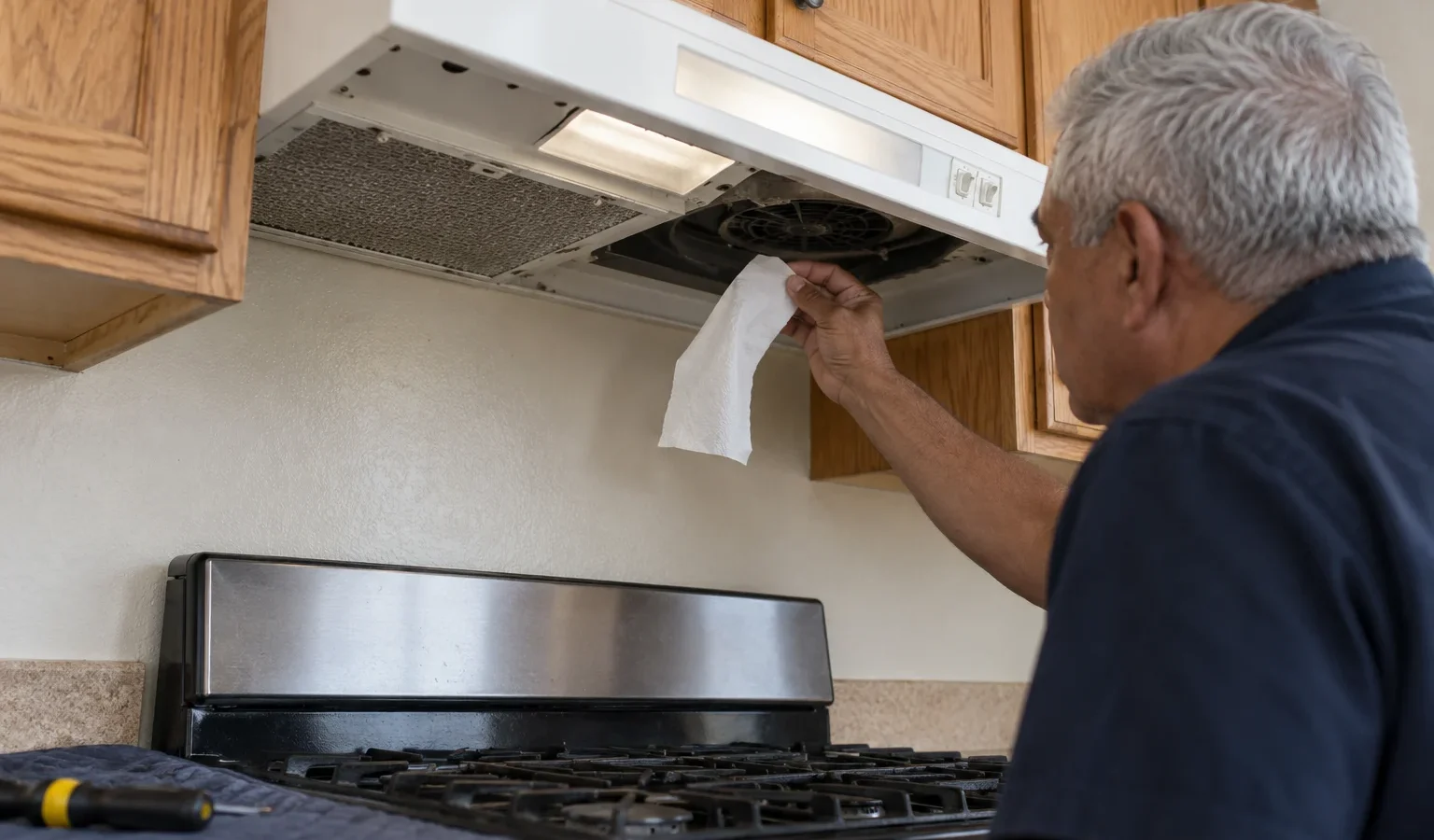
There are really two complaints under one heading. A silent fan does not move at all, which points to power, a switch or the motor. A weak fan runs but fails to clear smoke, which points to grease buildup, blocked ducting or a fan wheel that has slipped. Decide which one you have before looking at anything else.
Grease is the main enemy. A saturated filter blocks airflow, and grease that has reached the fan wheel throws it off balance and slows it down. Blocked or kinked ductwork, or an outside damper flap that sticks shut, reduces what leaves the building. In many San Francisco flats the hood vents through a long run to the exterior wall, or recirculates through a charcoal filter that needs replacing, and either arrangement shows the weakness first. A rattling sound often means the wheel has loosened or grease has built up on one side.
Keep your hands off the fan wheel and the motor. Everything beyond the filters and the exterior flap is for a technician.
Do not run the fan with the filters removed, do not spray cleaner into the motor housing, and do not climb onto the range to reach the hood. Do not touch wiring above the unit. If you smell burning, hear a grinding noise or see smoke, shut the hood off at the breaker. If you smell gas anywhere in the kitchen, leave and call the gas utility or 911 from outside.
How the hood is installed shapes how it fails. A ducted hood sends air out through a duct, so a blocked duct or stuck damper is common. A recirculating hood returns air to the room through a filter, so the filter condition matters. A hood above a high-output gas range works harder and picks up more grease. Mention which kind you have, how long the duct run is, and whether your range is gas or electric.
We check power at the hood, test the switch and control, inspect the motor and wheel, and look at the duct and damper. You receive a written estimate before any part is ordered, and nothing is repaired without your approval. See Kenmore range hood repair and Kenmore range hoods for what we cover. An over-the-range microwave with a built-in fan is a different appliance; for that see Kenmore microwave repair.
Grease filters need cleaning more often than most people expect, particularly in kitchens where frying, stir-frying or searing is routine. Wipe the underside of the hood and the visible fan area with a degreasing cloth only when the hood is off and cool, and avoid soaking the control panel. Turn the fan on a minute before cooking and leave it for a few minutes after, so it can clear steam and smoke instead of letting them settle on cabinets.
If your building has shared ducting, a weak hood can also be affected by what happens in other flats, such as a damper that sticks. When the problem is in the building duct rather than the hood, a technician will say so and point you to the building manager.
Many hoods have a rocker, slider or push-button switch for each speed, and a separate switch for the light. A single worn contact can leave one speed working and the others dead, which is a useful clue to share. Touch controls add a small board, and moisture from steam can get to it over time. If only one speed works, say which, and whether the problem began after cleaning the hood with liquid cleaners near the controls.
Motors, wheels and switches are specific to each hood. The label is usually found behind the filters on the inside of the housing. Our model pages, such as Kenmore 233.51303200 repair and Kenmore 233.51363200 repair, show how hood parts are grouped.
The light and fan share the control but use different parts. The fan switch, motor, thermal protector or wiring is the likely cause, so a technician should test it.
Grease in the filters or on the fan wheel, a blocked duct, a stuck outside damper or a worn recirculating filter are the usual reasons.
Wash metal grease filters regularly, more often if you cook with oil or fry food. A dry, clean filter keeps airflow strong.
Rattling usually means a loose wheel or grease buildup. Grinding, smoke or a burning smell means shut it off at the breaker and book a visit.
Yes. A ducted hood can lose airflow to the duct or damper, while a recirculating one depends on its filter. We check both.
Share a few details and we’ll confirm an appointment. Prefer to talk? Call us and we’ll help right away.